
 Cart is empty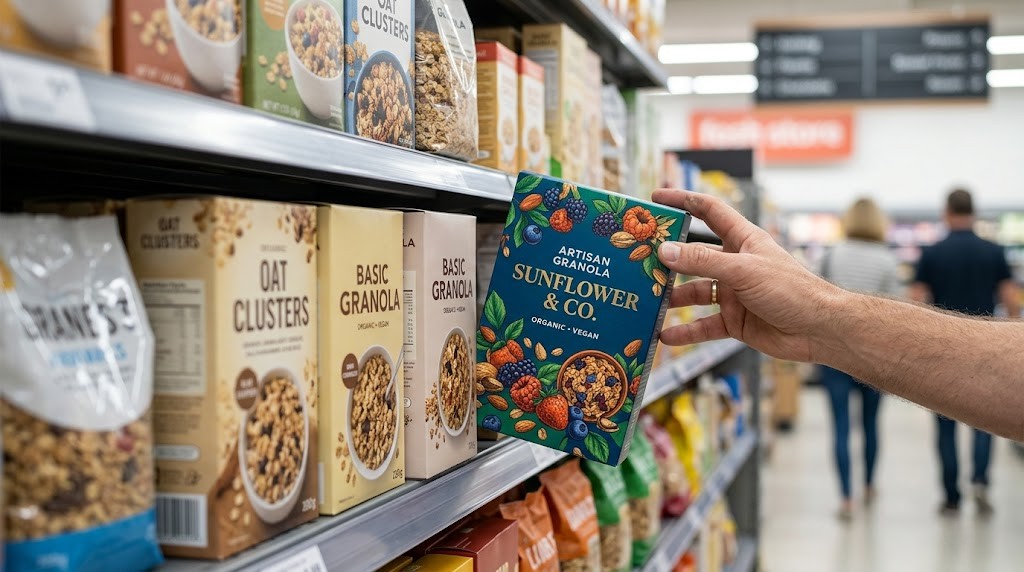
You have spent months developing your product. The recipe is dialled in. The flavour, the texture, the story behind it — everything is right. Then you go to place your first retail order and the buyer asks: “Can you send me your label artwork?” And that is where many Niagara food producers hit an unexpected wall.
Custom labels and packaging are not just aesthetics. They are the first — and sometimes only — interaction a customer has with your product before deciding whether to pick it up off the shelf or walk past it. In a market where Niagara food products increasingly compete alongside national brands in regional grocery stores, farm stands and online marketplaces, the quality and professionalism of your packaging directly affects whether your product sells.
This guide is for Niagara food producers — whether you are a small-batch jam maker in Pelham, a craft hot sauce producer in Welland, a specialty condiment brand in St. Catharines, or a farmers market vendor ready to move into retail. We cover what types of labels and packaging you need, what Canadian food labelling laws require, how to work with a local printer to get exactly what you need, and how to avoid the most common and costly mistakes food producers make with their first label run. Get a custom label and packaging quote from Niagara Print Express
Why Your Label Is Your Most Important Marketing Tool
Research in consumer psychology consistently shows that packaging influences purchasing decisions more than almost any other marketing channel for food products. A Nielsen study found that 64 percent of consumers try a new food product because the packaging catches their attention. For independent food producers competing against established brands with national distribution and large marketing budgets, packaging is the great equalizer — a well-designed, professionally printed label lets a small-batch Niagara producer compete visually with products from much larger companies.
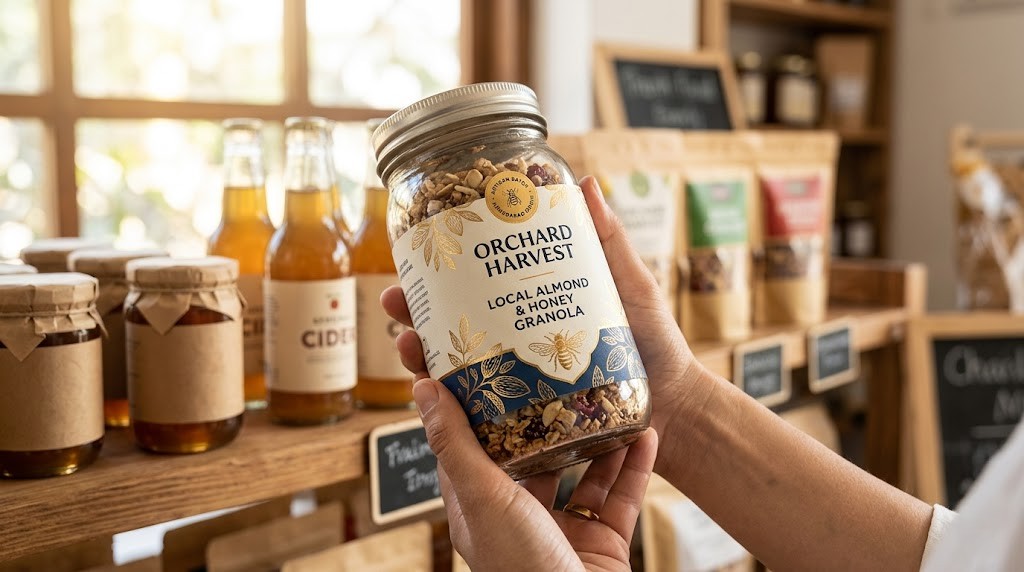
In the Niagara Region specifically, local food identity carries commercial value. Buyers at farm stands, specialty grocery stores and agri-tourism venues actively look for local provenance markers — Niagara Peninsula branding, regional imagery, handcrafted production language. Your label communicates all of this before a single word is read.
Beyond aesthetics, your label is also a legal document under Canadian food law — specifically the Safe Food for Canadians Regulations (SFCR) and the Food and Drug Regulations. Getting labelling requirements wrong is not just an embarrassment; it can result in products being pulled from retail, regulatory penalties and costly reprints. Read the Canadian Food Inspection Agency labelling requirements for food producers.

What Types of Custom Labels Do Niagara Food Producers Need?
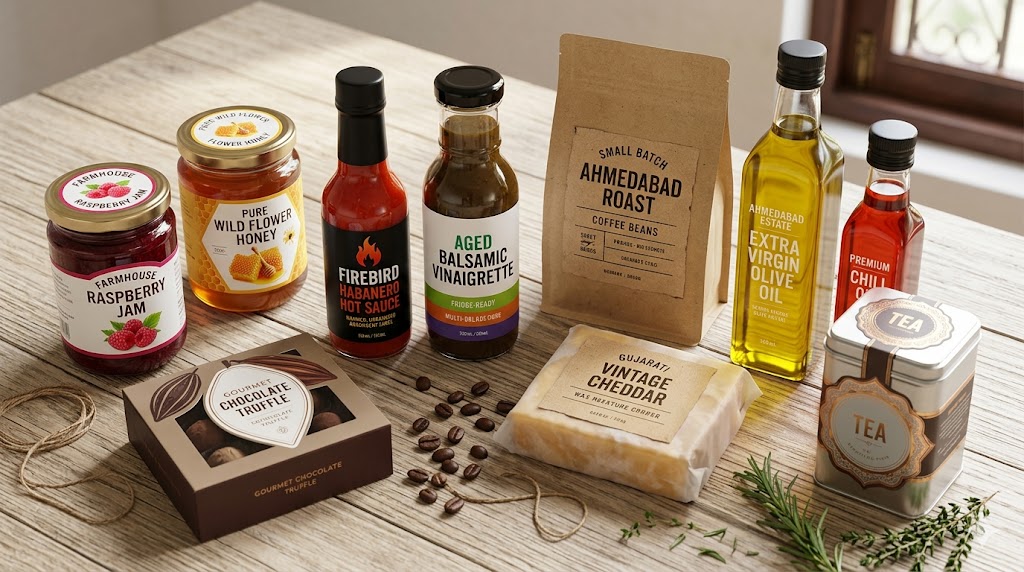
Not all food products need the same type of label. The right label for your product depends on the container material, storage conditions, application method and retail environment. Here is a breakdown of the main label types and when each is the right choice:
| Label Type | Best For | Material | Special Properties | Typical Niagara Use |
|---|---|---|---|---|
| Paper (Matte) | Dry goods, bakery, artisan products in ambient storage | Uncoated or matte-coated paper | Premium handcrafted look; not waterproof | Granola, baked goods, dry spice blends, tea |
| Paper (Gloss) | Jams, sauces, condiments in sealed jars | Gloss-coated paper | More vibrant colours; moderate moisture resistance | Jams, preserves, honey, marinades |
| BOPP (Polypropylene) | Wet environments, refrigerated products, bottles | Waterproof plastic film | Fully waterproof; squeezable containers; dishwasher-safe | Hot sauces, salad dressings, craft beverages |
| Kraft / Recycled Paper | Artisan, eco-conscious brand positioning | Natural recycled paper stock | Eco brand signal; rustic premium aesthetic | Organic products, farmers market specialty items |
| Clear Labels | Minimalist “no-label” premium look | Transparent film (BOPP or PET) | Shows container through label; high-end positioning | Craft spirits, premium olive oils, specialty vinegars |
| Die-Cut Labels | Non-rectangular container shapes; standout shelf presence | Any stock cut to custom shape | Custom outlines (round, oval, shaped) — not just rectangles | Wine, craft beer, gourmet gift sets, specialty bottles |
For most Niagara food producers starting their first label run, gloss paper labels for jarred products and BOPP waterproof labels for bottles and refrigerated items cover the majority of use cases. As your brand matures and you move into multiple SKUs or premium retail channels, die-cut and clear labels significantly elevate shelf presence.
Unsure which label material is right for your product and container? Contact the Niagara Print Express team for a label consultation — we work with food producers across the Niagara Region and can guide your material choice based on your specific product, container type and retail environment.
Canadian Food Labelling Requirements: What Must Appear on Your Label?
Canadian food labelling is governed primarily by the Safe Food for Canadians Regulations (SFCR) and the Food and Drug Regulations, both enforced by the Canadian Food Inspection Agency (CFIA). Non-compliance means products cannot legally be sold in Canadian retail — and for producers supplying grocery stores or specialty food shops, a buyer’s compliance check will catch missing information before your product ever reaches the shelf.
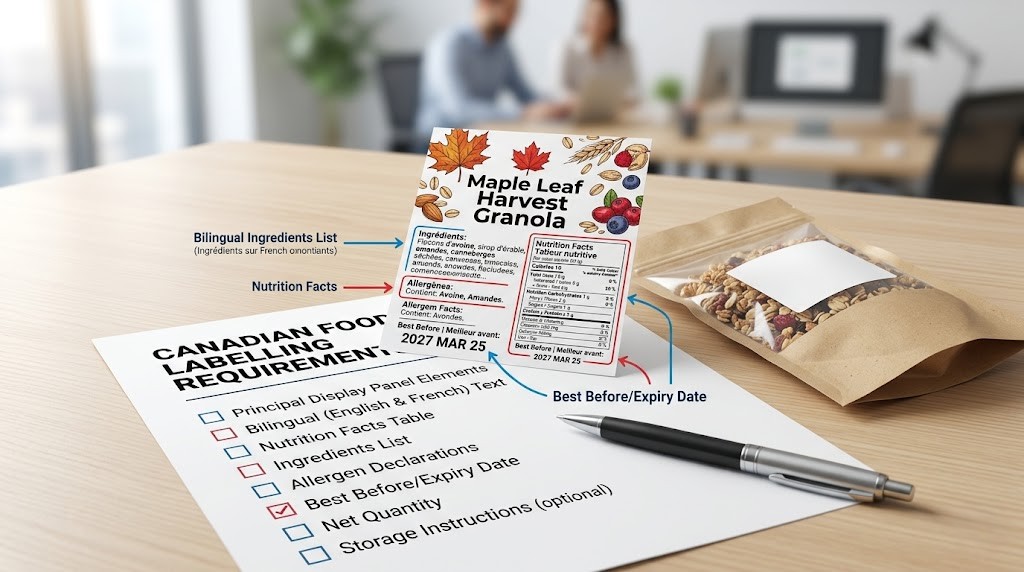
The following information is mandatory on most pre-packaged food products sold in Canada:
- Product name — must accurately describe the food (e.g., "Strawberry Jam" not just "Preserves")
- Net quantity — declared in metric units (grams, millilitres, kilograms, litres) for Canadian market
- List of ingredients — in descending order of proportion by weight; all sub-ingredients declared
- Allergen declaration — the 14 priority allergens must be clearly declared (peanuts, tree nuts, milk, eggs, wheat, soy, sesame, seafood, etc.)
- Nutrition Facts table — required for most packaged foods; specific format and font size regulated by CFIA
- Name and address of the manufacturer or distributor in Canada
- Country of origin — for products not manufactured in Canada
- Best before or expiry date — in the correct Canadian format (YYYY MM DD)
- Storage instructions — if required for safe storage
- Lot/batch code — recommended for traceability; required for some product categories
Bilingual requirements (English and French) apply to most pre-packaged foods sold nationally or across provincial borders. For producers selling exclusively within Ontario at farmers markets or through local retail, English-only labelling may be permitted — but always verify with the CFIA for your specific distribution channels. Review the full CFIA food labelling requirements guide before finalizing your label design.
IMPORTANT: Niagara Print Express prints your labels exactly as designed and submitted. We do not review label content for regulatory compliance — that is the food producer’s responsibility. Always have your label content reviewed by a food regulatory consultant or the CFIA before your first print run. We are experts in printing; your regulatory advisor is the expert in food law.
Beyond Labels: Other Packaging Print Products for Food Producers
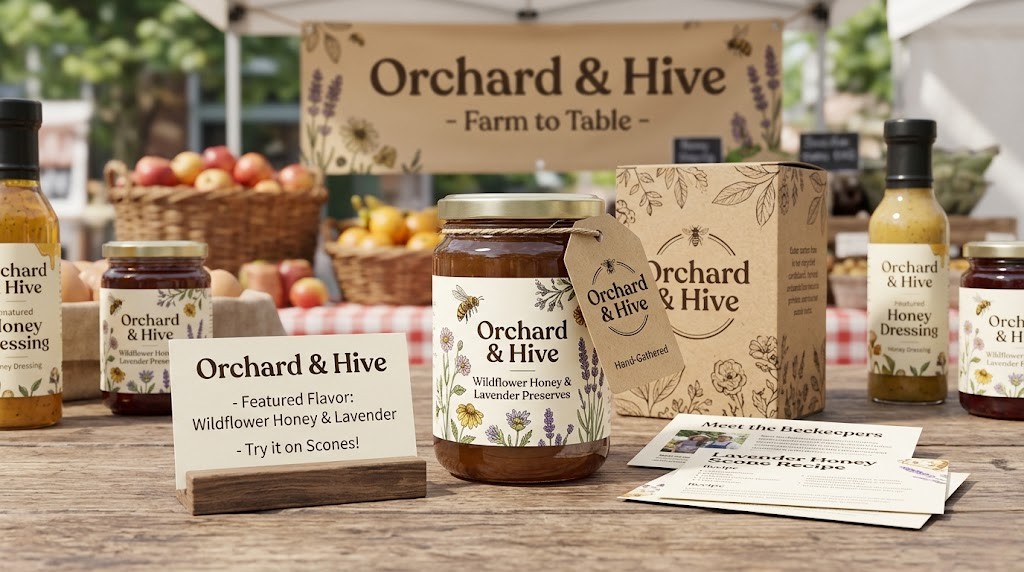
A complete packaging strategy for a Niagara food brand typically involves more than just the product label. As you grow from farmers market vendor to retail supplier, these additional print elements become important:
- Shelf talkers and price cards — small printed cards displayed on shelf edges to highlight your product in retail environments
- Hang tags — attached to bottles, jars or bags with product story, serving suggestions or brand narrative; particularly effective for gift or premium positioning
- Outer carton and shipping box labels — required for retail wholesale orders; case labels communicate product, quantity, lot code and storage requirements
- Promotional insert cards — placed inside multipack or gift sets; recipes, brand story, social media handles
- Farmers market display materials — table signs, banner stands, product display cards — all printable locally
- Gift box printing — custom printed rigid boxes for holiday gift sets, agri-tourism retail and premium positioning
For large format display materials — banners, signage and farmers market displays — see our large format printing services for Niagara businesses.
How to Order Custom Labels from Niagara Print Express: Step-by-Step
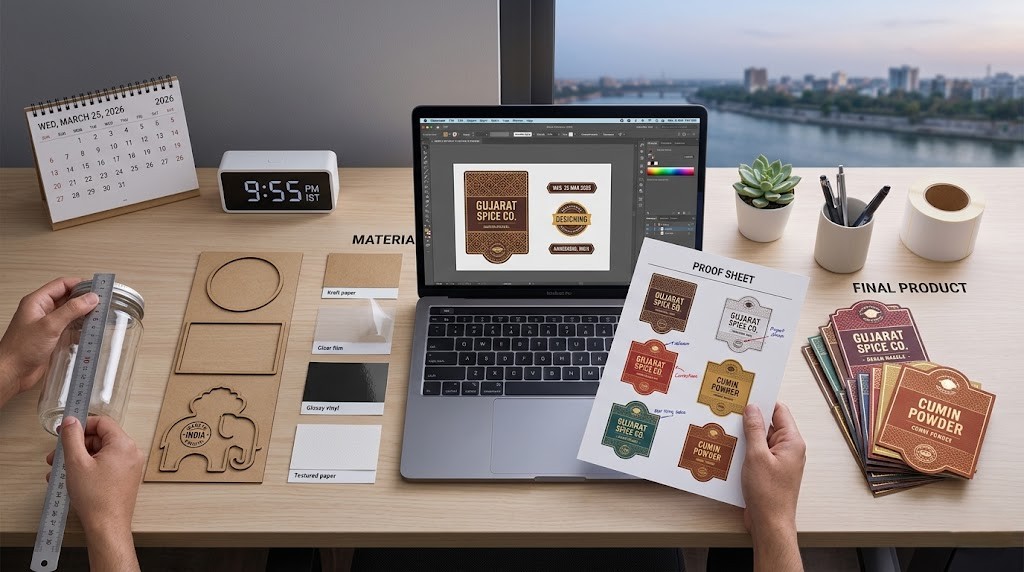
Many food producers ordering custom labels for the first time are unsure what information to provide and in what format. Here is the complete process from first contact to finished labels in your hands:
- Measure your containers — provide the exact dimensions of the label area on your jar, bottle or package (height × width for wrap-around labels; diameter for circular labels on jar lids)
- Determine your label shape — rectangle, circle, oval or custom die-cut; standard shapes are most cost-effective for small runs
- Confirm material requirements — tell us your product type, storage temperature, container material and whether the label area gets wet; we recommend the right stock
- Prepare or commission your artwork — your label file must be at 300 DPI with correct bleed (0.0625"–0.125" for labels) in CMYK colour mode; we offer graphic design services if you need artwork created or refined
- Submit your file for pre-press review — we check resolution, bleed, colour mode and safety margins before printing
- Proof approval — we send a digital proof for your approval; for first-time label runs, we strongly recommend a physical proof print at additional cost
- Print and collect — standard turnaround is 2–3 business days for label runs; rush same-day label printing available for urgent orders in Niagara
Not sure if your label artwork is print-ready? Our pre-press review catches resolution issues, incorrect colour profiles and missing bleed — the three most common label file problems. Learn about print-ready file requirements in our complete guide or contact us directly for a file check before you start your order.
Label Design Principles That Actually Sell Niagara Food Products
Professional label printing only amplifies what is already in the design — a well-printed poor design is still a poor design. These principles apply specifically to food products in the Niagara retail context:
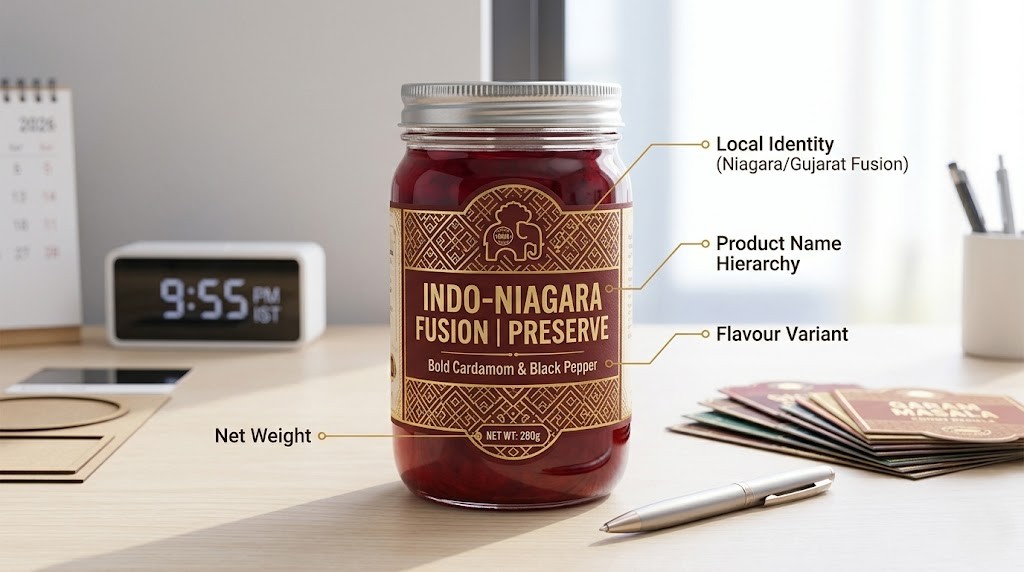
Lead with Local Identity
Niagara origin is a genuine selling point — particularly in farm stands, specialty grocery stores, agri-tourism venues and online marketplaces where buyers actively seek regional products. “Made in Niagara,” “Niagara Peninsula,” “Grown in the Niagara Escarpment” — these signals carry value that national brands cannot replicate. Make your regional identity prominent, not buried in fine print.
Hierarchy Matters More Than Decoration
The most important information on your label — product name, flavour variant, net weight — must be the most visually dominant. Many first-time food label designers over-invest in decorative elements and under-invest in legibility. A label that cannot be read from 60 centimetres away on a retail shelf is not doing its primary job.
Colour Psychology for Food
Colour communicates before the text is read. Green signals natural/organic. Red and orange stimulate appetite and communicate heat/spice. Brown and kraft signals artisan/premium. White signals clean/pure. Align your label colour palette with the product’s positioning and the emotion you want to trigger at the point of purchase.
For help developing label artwork that is both compliant and compelling, Niagara Print Express graphic design services can work from your brand guidelines or build a label identity from scratch — including logo, colour palette and label layout for all your SKUs.
5 Costly Label Mistakes Niagara Food Producers Make on Their First Run
| Mistake | What Happens | How to Avoid It |
|---|---|---|
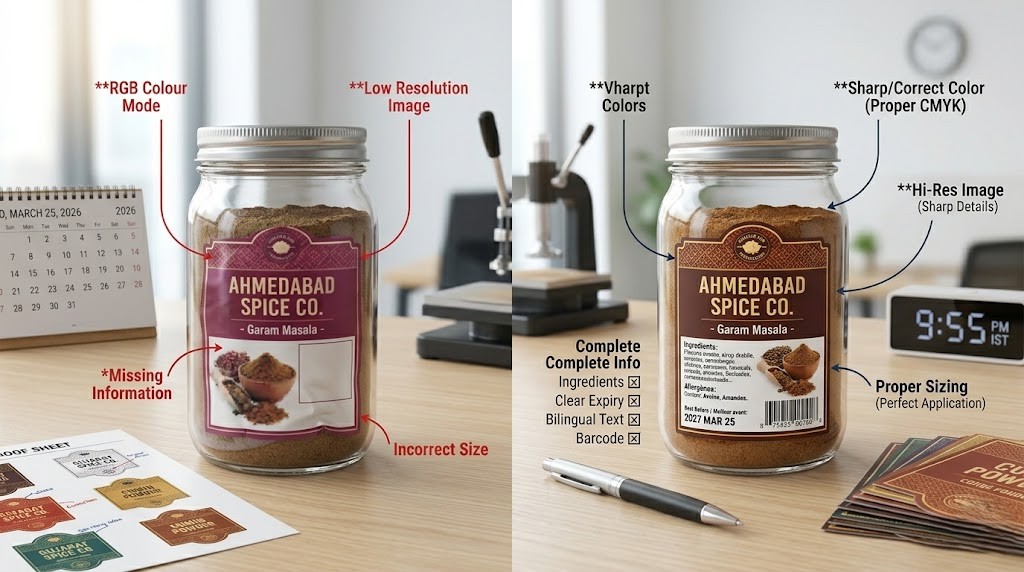
| Ordering Too Many Labels Before Testing Retail | Minimum print runs feel economical per-label but lock you into a design before market feedback; labels become obsolete when you rebrand | Order a smaller first run (100–500 labels); test in market before committing to 2,000+ |
| Using RGB Colour Mode Instead of CMYK | Colours shift when printed — vibrant screen blues become muted; bright reds shift orange | Always design food labels in CMYK mode; submit files in CMYK PDF |
| Low Resolution Images or Logos | Your logo appears blurry or pixelated on the final label; unprofessional appearance at point of sale | Ensure all images and logos are at minimum 300 DPI at actual print size |
| Missing Mandatory CFIA Information | Product pulled from retail; buyer compliance rejection; potential regulatory action | Have a food regulatory consultant review all mandatory content BEFORE submitting for printing |
| Wrong Label Size for Container | Labels too small leave visible container areas; labels too large wrinkle or overlap; both look amateur | Measure your actual container with a flexible tape; account for wrap-around overlap on curved surfaces |

Why Niagara Food Producers Choose a Local Printer Over Online Label Services
Online label printing services like Sticker Mule, Avery WePrint or Vistaprint offer competitive pricing on large runs — but they come with trade-offs that matter particularly for small-batch food producers who are iterating quickly on products, branding and compliance.
- No pre-press human review — automated systems approve files that a trained pre-press team would flag; you discover problems after printing
- Minimum order quantities can be too high for small-batch testing — many online services require 250–500 labels minimum even for digital proofs
- Shipping times add 5–10 business days to lead times — problematic when you have a farmers market this weekend or a retail buyer who needs product by Friday
- No local design support — if your artwork needs revision, you manage it entirely remotely with no local resource to call
- No accountability for compliance gaps — online services print exactly what you submit with no local knowledge of CFIA requirements
Niagara Print Express works with local food producers as a hands-on partner — not just a file processor. We have helped Niagara Region producers navigate label specifications for everything from artisan honey jars to craft hot sauce bottles to specialty baked goods packaging. Our same-day printing capability means that when you have an urgent retail order or a last-minute farmers market opportunity, your labels are not waiting in a shipping queue from an out-of-province facility.
We serve Pelham, St. Catharines, Welland, Niagara Falls and the surrounding Niagara Region. Learn about our same-day printing services for urgent label and packaging orders.
Your Niagara Food Product Deserves a Label That Matches Its Quality
The Niagara Region has a food production story worth telling. From the fruit belt on the Escarpment to the craft beverage producers along the wine route, to the artisan food makers at farmers markets across Pelham, Welland, Thorold and St. Catharines — this region produces food that competes with anyone. The missing piece for many of these producers is packaging that communicates that quality before the first taste.
Custom labels and packaging are not a luxury reserved for large food brands. With digital printing technology, small-batch food producers in Niagara can access professionally designed, properly compliant, beautifully printed labels at run sizes that match their production volumes — and with turnaround times that match the pace of local business.
Niagara Print Express works with local food producers from first label through retail scale-up. Request your custom label quote today — local consultation, pre-press review included, same-day printing available for urgent orders across the Niagara Region.

We print almost everything!
Didn't find what you're looking for?
We print almost everything! Contact us for custom requests.
Frequently Asked Questions (FAQs)
What is the minimum order quantity for custom labels at Niagara Print Express?
Minimum order quantities vary depending on label material, size and finishing. Digital label printing allows smaller runs than offset printing — making it cost-effective for small-batch food producers who need 100–500 labels to start. Contact us with your label size and material requirements for an accurate minimum order quote.
What file format should I submit for custom label printing?
Submit print-ready PDF files in CMYK colour mode at 300 DPI resolution with the correct bleed (typically 0.0625"–0.125" on all sides for labels). Adobe Illustrator (AI), EPS and high-resolution TIFF files are also accepted. If you are designing in Canva, export as PDF Print with crop marks and bleed enabled. We will review your file before printing and contact you if there are any issues.
Can Niagara Print Express design my food label from scratch?
Yes — our graphic design team can create your complete food label design including logo, typography, colour palette, regulatory content layout and print-ready artwork for all SKUs. Bring your product, your brand story and any existing brand materials to a design consultation and we will handle the rest.
What are the mandatory requirements for food labels in Ontario/Canada?
Under the Safe Food for Canadians Regulations (SFCR), mandatory elements for most pre-packaged foods include: product name, net quantity in metric, ingredients list (descending by weight), allergen declarations, Nutrition Facts table, manufacturer name and Canadian address, best before date, and lot code. Bilingual English/French labelling is required for national distribution. Always verify your specific requirements with the CFIA or a food regulatory consultant.
How long does custom label printing take at Niagara Print Express?
Standard turnaround for custom labels is 2–3 business days from file approval. Rush and same-day label printing is available for urgent orders — contact us to confirm availability for your specific label type and quantity. Same-day service is available for our most common label stocks. We serve the Niagara Region with local pickup in Pelham and local delivery to St. Catharines, Welland and Niagara Falls.
What is the difference between BOPP and paper labels for food products?
Paper labels (matte or gloss) are cost-effective for dry goods and ambient-storage products in sealed jars or boxes. BOPP (biaxially-oriented polypropylene) labels are a waterproof plastic film material that withstands moisture, condensation and refrigeration — essential for bottles, refrigerated products, craft beverages and any application where the label surface gets wet. BOPP labels also resist tearing and have stronger adhesion on curved surfaces.
Can I get die-cut labels in custom shapes for my food products?
Yes — Niagara Print Express produces die-cut labels in custom shapes including circles, ovals, rounded rectangles, and fully custom contours. Die-cut labels significantly improve shelf presence compared to standard rectangular labels and are popular with premium food brands, craft beverages and specialty food gift products. Setup costs apply for custom die shapes; standard shapes (circle, oval) have no additional die setup fee.
Do I need different labels for farmers market vs retail grocery sales?
The content requirements are similar, but presentation standards differ. Farmers market labels can be simpler and more handcrafted in appearance. Retail grocery buyers typically expect more polished, brand-consistent labelling with full CFIA compliance, UPC barcodes (for scanning at checkout), and nutrition facts tables. If you plan to scale from farmers market to retail, design your label to retail standard from the start — it is more cost-effective than redesigning later.
How do I know what size label I need for my jar or bottle?
For flat-sided containers (jars, boxes, pouches): measure the available label area height and width directly. For cylindrical containers (bottles, round jars): measure the circumference (diameter × 3.14) for wrap-around label width, and the available height for label height — subtract 10–15mm from both dimensions to avoid label edges touching container curves at top and bottom. If unsure, bring your container to Niagara Print Express and we will measure and recommend dimensions on the spot.
Can Niagara Print Express add barcodes to my food labels?
We can print barcodes on food labels if you provide a valid GS1-registered UPC barcode file as part of your artwork. Niagara Print Express does not register barcodes — that is done through GS1 Canada. Once you have your GS1-registered UPC, provide the barcode file at the correct size (minimum 80% of nominal size for retail scanning) and we will incorporate it into your label print file or check existing artwork for correct scaling.

Shadab Alam
Shadab Alam is an entrepreneur and co-founder of NPE, specializing in print marketing, branding, and business growth strategies. With experience in building and scaling business initiatives, he focuses on helping companies use high-quality printed materials and creative marketing to strengthen their brand presence.
Add a Comment