
 Cart is empty
Table of Contents
Should you invest in office printing equipment or outsource to a professional printing service?
This question confronts every business owner in the Niagara Region at some point. The answer seems obvious—buying your own printer must be cheaper than paying a printing company, right? Not so fast.
The true cost of in-house printing extends far beyond the initial equipment purchase. When you factor in supplies, maintenance, labour, waste and opportunity cost, many businesses discover they’re actually losing money by printing internally.
Let’s break down the real numbers so you can make an informed decision based on facts, not assumptions. Whether you’re a startup weighing your options or an established business reconsidering your printing strategy, this analysis will show you exactly when each approach makes financial sense.
At Niagara Print Express, we help Niagara Region businesses achieve consistent, accurate print colours through expert file checks, proofs, and colour consultation.

The True Cost of In-House Printing
Most businesses dramatically underestimate what in-house printing actually costs. The printer purchase price is just the beginning.
Complete In-House Printing Cost Breakdown
| Cost Category | Initial Investment | Annual Ongoing Cost |
|---|---|---|
| Printer/Copier Equipment | $3,000–15,000 | — |
| Maintenance Contract | — | $800–2,500 |
| Toner/Ink Cartridges | — | $1,200–4,800 |
| Paper Stock (various types) | — | $600–1,500 |
| Electricity | — | $200–400 |
| Equipment Depreciation | — | $600–3,000 |
| Staff Time (printing, troubleshooting) | — | $2,000–8,000 |
| Waste & Misprints | — | $400–1,200 |
| Storage Space | — | $300–900 |
| TOTAL FIRST YEAR | $3,000–15,000 | $6,100–22,300 |
| TOTAL 5-YEAR COST | — | $33,500–126,500 |
Let’s examine each cost category in detail.
Equipment Costs: Beyond the Sticker Price
The initial equipment investment varies dramatically based on your needs:
Basic Office Laser Printer:
- Cost: $300-800
- Good for: Black and white documents, low volume (under 500 pages/month)
- Limitations: Poor colour quality, slow, limited paper sizes
Mid-Range Colour Copier:
- Cost: $3,000-8,000
- Good for: Mixed black/white and colour documents, medium volume (1,000-3,000 pages/month)
- Limitations: Consumer-grade colour, limited paper stock options, no specialty finishes
Professional Production Printer:
- Cost: $15,000-50,000+
- Good for: High volume, colour-critical work, varied materials
- Limitations: Requires dedicated operator, significant space, steep learning curve
A Grimsby retail business invested $12,000 in a colour copier thinking they’d save money on flyers and promotional materials. After 18 months, they calculated their actual per-unit costs and discovered they were paying more than if they’d used Niagara Print Express from the start—plus their print quality was noticeably inferior.
Ongoing Supply Costs: The Hidden Drain
Toner and ink cartridges create a continuous expense that catches businesses off guard.
Cost Per Page Reality:
| Print Type | In-House Cost Per Page | Volume Needed for Break-Even |
|---|---|---|
| Black & White Document | $0.03–0.08 | Very high |
| Colour Document | $0.12–0.25 | Extremely high |
| Colour Marketing Flyer | $0.40–0.75 | Almost never breaks even |
| Business Card (per card) | $0.25–0.45 | Never economical |
These per-page costs don’t include labour, waste or equipment depreciation.
Staff Time: Your Most Expensive Resource
The hidden killer of in-house printing economics is staff time. Someone needs to:
- Load paper and supplies (15-30 min/week = $400-800/year)
- Clear paper jams and troubleshoot (30-60 min/week = $800-1,600/year)
- Perform routine maintenance (15 min/week = $400/year)
- Order supplies and manage inventory (1 hour/month = $400/year)
- Cut, trim and finish materials (2-5 hours/week = $3,000-7,000/year for marketing materials)
A Pelham accounting firm calculated that their office manager spent 4 hours weekly managing their in-house printing—time worth approximately $4,800 annually. That’s $4,800 not spent on revenue-generating activities.
Waste & Quality Issues
Every business with in-house printing experiences:
- Misprints and user errors (5-15% of materials)
- Colour inconsistencies requiring reprints
- Paper jams destroying materials
- Outdated inventory when designs change
- Poor quality forcing external reprints anyway
One St. Catharines marketing agency tracked their waste over three months: 22% of their in-house prints had issues requiring reprinting or were discarded due to quality problems. That’s throwing away more than $1 out of every $5 spent on supplies.

The True Cost of Professional Printing Services
Professional printing often appears more expensive at first glance because you see the complete cost upfront. However, this transparency reveals the actual economics. the real cost of professional printing
Professional Printing Cost Structure
| Print Project | Professional Cost | In-House “Visible” Cost | In-House TRUE Cost |
|---|---|---|---|
| 500 Flyers (Full Colour) | $120–180 | $75–100 (supplies only) | $200–350 (all factors) |
| 1,000 Business Cards | $150–200 | $120–180 (supplies only) | $400–600 (all factors) |
| 100 Presentation Folders | $180–250 | Can’t produce professionally | N/A |
| 2,000 Brochures (Tri-Fold) | $400–600 | $200–300 (supplies only) | $800–1,400 (all factors) |
What's Included in Professional Pricing
When you pay a commercial printing service in Ontario, you receive:
Design & Pre-Press:
- File review and correction
- Colour optimization and proofing
- Proper bleed and resolution setup
- Expert recommendations on paper and finishes
Production:
- Professional equipment producing consistent results
- High-quality materials and inks
- Precision cutting and finishing
- Quality control inspection
Convenience:
- No equipment maintenance
- No supply inventory management
- No staff time allocation
- No storage requirements
- Professional consultation
Guarantee:
- Reprints for any quality issues
- Consistent results project after project
- Colour matching across print runs
- Deadline commitments
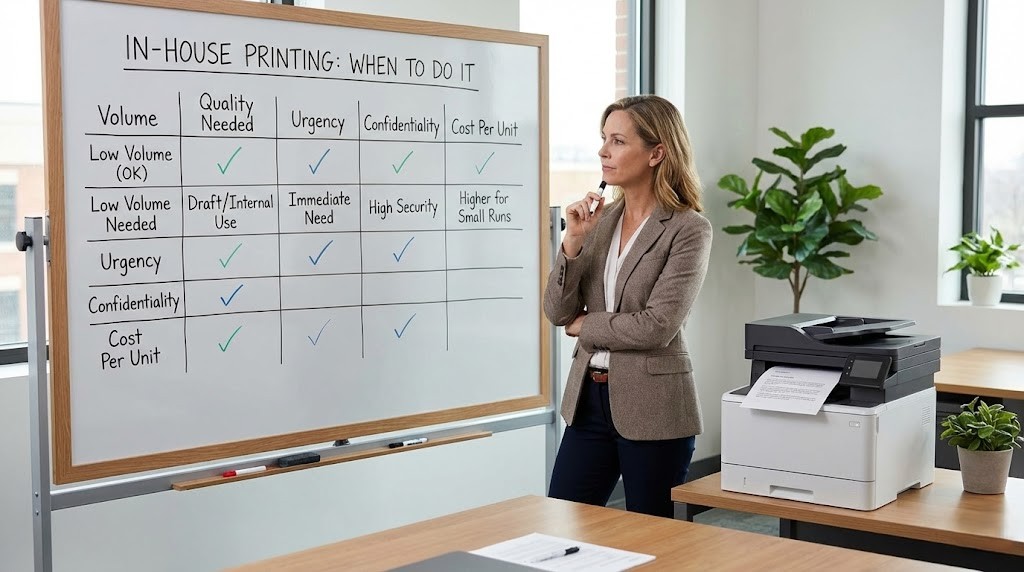
Decision Matrix: When to Print In-House vs Outsource
The right choice depends on your specific situation. Here’s a practical framework for making the decision. flyer printing Niagara
Print In-House When...
| Scenario | Why It Works | Maximum Monthly Volume |
|---|---|---|
| Simple Black & White Documents | Low per-page cost, no quality concerns | Under 5,000 pages |
| Internal-Only Materials | Quality standards less critical | Any volume |
| Immediate Need (Under 2 Hours) | No time for outsourcing | Occasional |
| Confidential / Sensitive Documents | Security requires in-house control | As needed |
| Draft Versions for Review | Quality not final-ready | Unlimited drafts |
Use Professional Printing When...
| Scenario | Why It Works | Typical Savings |
|---|---|---|
| Marketing Materials (Flyers, Brochures) | Quality critical, cost per unit lower | 30–60% vs in-house |
| Business Cards & Branded Materials | Professional finish essential, consistent colour | 40–70% vs in-house |
| Large Volume (1,000+ Units) | Economics of scale make professional cheaper | 50–80% vs in-house |
| Specialty Materials (Cardstock, Glossy) | Equipment and expertise required | Can’t produce in-house |
| Colour-Critical Work | Professional colour management | Eliminates waste / reprints |
| Projects Requiring Finishing (Folding, Binding) | Equipment and labour prohibitive in-house | 60–90% vs attempting in-house |
The Hybrid Approach
Many successful Niagara Region businesses use a hybrid strategy that maximizes both efficiency and economy:
Print In-House:
- Black and white internal documents
- Draft versions and proofs
- Immediate-need confidential materials
- Simple forms and worksheets
Print Professionally:
- All external marketing materials
- Business cards and stationery
- Brochures, flyers and promotional items
- Large format posters and banners
- Anything requiring special finishes or materials
This approach optimizes your investment by using each method where it provides the best value.
Real-World Case Studies from the Niagara Region
Let’s examine three local businesses that made different choices—and their outcomes.
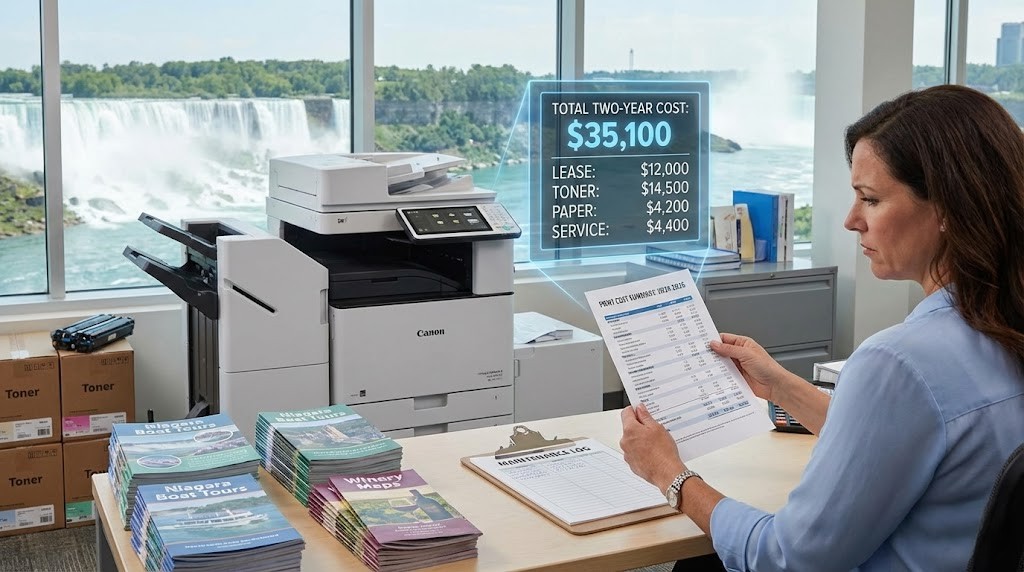
Case Study #1: The False Economy
Business: Niagara Falls tourism company, 12 employees
Decision: Purchased $8,500 colour copier for marketing materials
Results over 2 years:
- Equipment cost: $8,500
- Supplies and maintenance: $14,200
- Staff time (estimated): $9,600
- Waste and reprints: $2,800
- Total 2-year cost: $35,100
Alternative if outsourced: $18,000-22,000 for same materials professionally printed
Actual overspend: $13,100-17,100 (42-49% more expensive)
They eventually switched to professional printing and now save approximately $450 monthly while getting better quality.
Case Study #2: The Right In-House Investment
Business: Pelham law office, 8 employees
Decision: Purchased $1,200 black/white laser printer for documents
Results over 2 years:
- Equipment cost: $1,200
- Supplies: $1,800
- Maintenance: Minimal (under warranty)
- Staff time: Under 2 hours monthly = $1,200
- Total 2-year cost: $4,200
Alternative if outsourced: $6,500-8,000 for same volume
Actual savings: $2,300-3,800
They still outsource all colour marketing materials to Niagara Print Express and have achieved the optimal balance.
Case Study #3: The Total Outsource Strategy
Business: St. Catharines consulting firm, 5 employees
Decision: Zero in-house printing, 100% outsourced
Results over 2 years:
- Equipment cost: $0
- Professional printing costs: $8,400
- Staff time managing printing: Under 10 hours total = $400
- Total 2-year cost: $8,800
Alternative if in-house: $15,000-20,000 for equipment plus ongoing costs
Actual savings: $6,200-11,200
They maintain superior quality, zero equipment headaches and redirect staff time to billable client work.

Calculating Your Break-Even Point
Want to know if in-house printing makes sense for your business? Use this framework to calculate your specific break-even point.
Monthly Volume Break-Even Calculator
| Print Type | Professional Cost Per Unit | In-House Cost Per Unit | Monthly Volume for Break-Even |
|---|---|---|---|
| Black & White Documents | $0.08–0.12 | $0.03–0.08 | 3,000–5,000+ pages |
| Colour Documents | $0.20–0.35 | $0.12–0.25 | 2,000–4,000+ pages |
| Marketing Flyers | $0.12–0.24 | $0.40–0.75 | Never (professional cheaper) |
| Business Cards | $0.12–0.20 | $0.25–0.45 | Never (professional cheaper) |
Key Insight: Even at high volumes, marketing materials are typically cheaper professionally due to equipment capabilities, buying power on materials and economies of scale.
Your Personal Break-Even Formula
Calculate whether in-house printing makes financial sense:
Step 1: Estimate your annual printing costs professionally = A
Step 2: Calculate total in-house costs (equipment ÷ 5 years + annual supplies + staff time + waste) = B
Step 3: Compare: If B < A by at least 30%, in-house might work. If not, outsource.
The 30% buffer accounts for unexpected costs, quality issues and opportunity cost of staff time.

Hidden Factors That Tip the Scale
Beyond pure dollars, consider these often-overlooked factors in your decision.
Quality & Brand Impact
Professional Advantage: Your marketing materials represent your brand. Poor print quality signals “amateur” or “budget operation” to potential clients—regardless of your actual expertise or pricing.
A Niagara-on-the-Lake winery learned this lesson when their in-house printed wine labels looked washed out compared to competitors. After switching to professional printing, sales representatives reported an immediate improvement in buyer perception. offset vs digital printing quality
Flexibility & Options
| Capability | In-House Printer | Professional Printing |
|---|---|---|
| Paper Stock Options | 2–3 types | 50+ options |
| Finishing Options | None or basic | Folding, binding, laminating, die-cutting, embossing |
| Size Options | Letter, legal, ledger | Any custom size |
| Colour Accuracy | Consumer-grade | Professional colour matching |
| Special Inks | Standard CMYK only | Metallics, spot colours, Pantone matching |
Professional printing provides creative options that in-house equipment simply cannot match.
Opportunity Cost of Staff Time
Every hour your team spends managing printing is an hour not spent on revenue-generating activities. For a business where staff hourly value is $40-100, this matters significantly.
Example: Your marketing manager spends 5 hours monthly managing in-house printing = $2,400-6,000 annually. Could that time generate more value elsewhere in the business?
Cash Flow Considerations
In-House: Large upfront equipment investment plus ongoing supply costs
Professional: Pay only for what you need, when you need it—preserving cash flow for other business investments
Many Niagara Region startups benefit from the flexibility of professional printing during their growth phase, only considering in-house printing after reaching stable, predictable volumes.
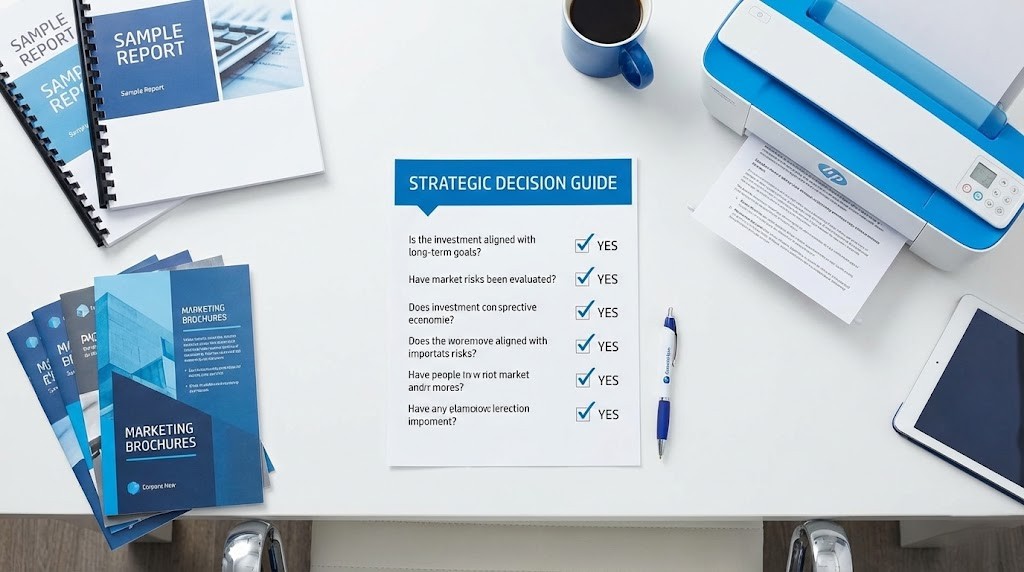
Making the Right Decision for Your Business
Here’s a practical decision tree to guide your choice:
Quick Decision Guide
Answer these questions:
1. Do you print more than 5,000 pages monthly?
- No → Outsource everything
- Yes → Continue to question 2
2. Is most of your printing black & white internal documents?
- Yes → Consider basic in-house B&W printer + outsource colour
- No → Continue to question 3
3. Do you need marketing-quality colour materials regularly?
- Yes → Outsource colour work (quality critical)
- No → Continue to question 4
4. Do you have dedicated staff time for printer management?
- No → Outsource (staff time too valuable)
- Yes → Consider hybrid approach
5. Is your annual professional printing cost over $15,000?
- No → Outsource (not enough volume to justify equipment)
- Yes → Hybrid approach likely optimal
The Optimal Setup for Most Small Businesses
Based on helping hundreds of Niagara Region businesses, here’s our recommendation for companies with 5-25 employees:
In-House:
- Purpose: Internal documents, drafts, immediate needs
- Monthly volume: Under 2,000 pages
- Cost: Under $1,500 annually all-in
Professional:
- Purpose: Business cards, brochures, flyers, promotional materials
- Provider: Local printing service (speed + relationship benefits)
- Cost: Variable based on needs, better ROI than in-house
This setup provides the best of both worlds: convenience for everyday documents and professional quality where it counts.

Key Takeaways: Smart Printing Investment Decisions
Making the right printing choice doesn’t require complex analysis—just honest assessment of your needs:
- Calculate TRUE in-house costs—equipment, supplies, labour, waste and opportunity cost, not just supplies
- Volume matters critically—under 5,000 pages monthly makes in-house economics questionable
- Quality impacts brand perception—poor printing quality costs you in ways spreadsheets don't capture
- Hybrid approaches work best for most businesses—basic B&W in-house plus professional colour outsourcing
- Staff time is expensive—don't undervalue the hours spent managing printing operations
The goal isn’t to never print in-house—it’s to print in-house only when it genuinely makes economic and operational sense. For everything else, partnership with a professional printing service provides better results for less total cost.
Your Printing Cost Analysis Partner
At Niagara Print Express, we help businesses throughout the Niagara Region make smart printing decisions—whether that means working with us or helping you optimize your in-house capabilities.
We offer:
- Free cost analysis consultations comparing in-house vs outsourcing for your specific situation
- Transparent pricing so you can make accurate comparisons
- Volume discounts that often beat in-house economics even at higher quantities
- Quick turnaround (often 1-3 days) reducing the "convenience advantage" of in-house printing
- Expert guidance on when each approach makes sense
We’d rather earn your business by providing genuine value than by keeping you in the dark about costs.
Ready to discover your optimal printing strategy? Visit our contact page to schedule a free cost analysis, or call us at (289) 897-9026 to discuss your printing needs. Check our resources library for additional cost calculators and planning tools. Let’s find the approach that maximizes your budget and delivers the quality your brand deserves.

We print almost everything!
Didn't find what you're looking for?
We print almost everything! Contact us for custom requests.
Frequently Asked Questions (FAQs)
Is it cheaper to print in-house or use a professional printing service?
It depends on your volume and the type of materials you are producing. In-house printing can be cost-effective for high-volume black-and-white internal documents. However, for colour marketing materials, business cards, and brand-sensitive items, professional printing is often significantly more economical when you factor in equipment costs, maintenance, labour, waste, and depreciation.
What is the true cost of in-house printing for a small business?
The true cost of in-house printing goes far beyond ink and paper. It includes equipment purchase or lease payments, toner and supplies, maintenance contracts, electricity, staff time for troubleshooting and finishing, wasted prints, and storage space. For many small to mid-sized businesses, the annual cost can range from several thousand dollars to over twenty thousand dollars depending on volume and equipment.
When does in-house printing actually make financial sense?
In-house printing typically makes sense when a business prints a high volume of black-and-white internal documents and does not require premium quality or specialty finishes. It can also be practical for confidential documents or urgent materials needed immediately. For most marketing and branded materials, however, professional printing remains the more cost-effective option.
Why are marketing materials usually cheaper when printed professionally?
Professional printers benefit from industrial-grade equipment, bulk purchasing power for paper and supplies, advanced finishing capabilities, and lower waste rates. These efficiencies reduce the cost per unit for flyers, brochures, and business cards, often making them less expensive than producing them in-house, especially when quality expectations are high.
How does staff time impact the cost of in-house printing?
Staff time is one of the most overlooked costs in printing decisions. Managing equipment, clearing paper jams, ordering supplies, cutting and finishing materials, and troubleshooting issues all consume valuable employee hours. When those hours are calculated at standard wage rates, the cost can add up to thousands of dollars annually.
What is the best printing strategy for most small businesses?
For many small businesses, a hybrid strategy works best. Using a basic office printer for internal black-and-white documents provides convenience, while outsourcing colour marketing materials, business cards, brochures, and specialty projects ensures professional quality and better overall cost efficiency.
Add a Comment