
 Cart is empty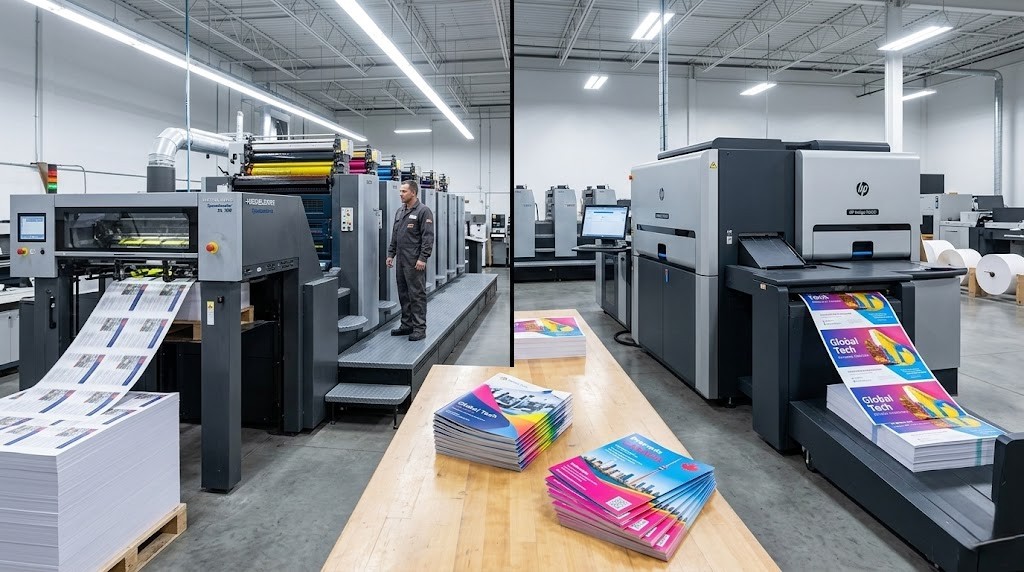
You’ve finalized your design, chosen your paper and you’re ready to print. Then your printer asks: “Do you want offset or digital printing?”
If you’re like most business owners in the Niagara Region, this question creates confusion. What’s the difference? Does it matter? And how do you choose?
The printing method you select significantly impacts your project’s cost, quality, timeline and capabilities. Choose wrong and you might overpay by 50-100% or compromise quality unnecessarily. Choose right and you get exactly what you need at the best possible value. print resolution and DPI
Whether you’re printing business cards, marketing brochures, or large-format materials, understanding offset versus digital printing empowers you to make informed decisions. Let’s break down both methods so you can confidently choose the approach that best serves your project.
What is Offset Printing?
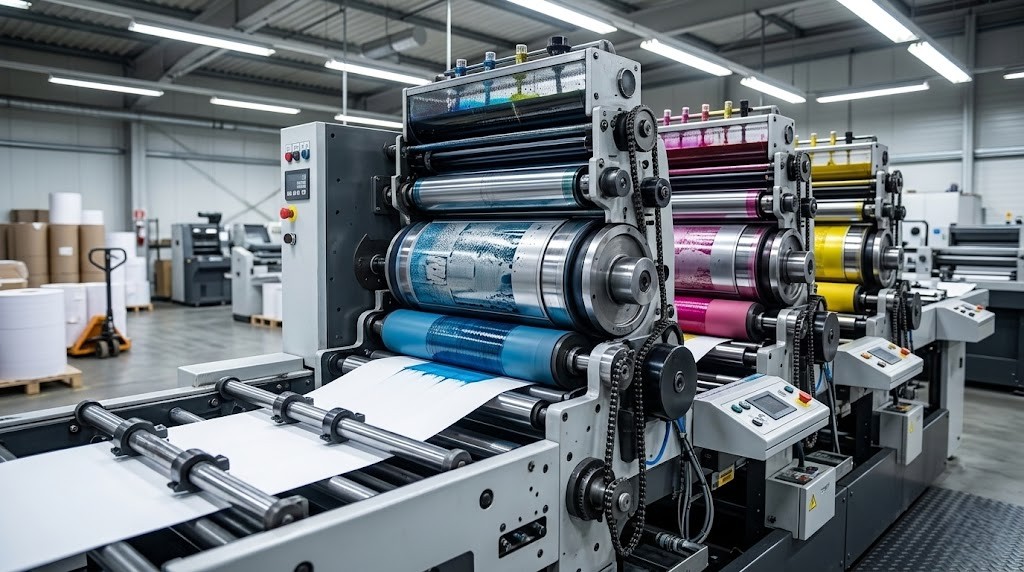
Offset printing, also called lithographic printing, is the traditional method that’s dominated commercial printing for over a century. It’s the technique used for newspapers, magazines, books and most high-volume printing. offset lithography process
How Offset Printing Works
The process involves multiple steps:
- Plate Creation: Your design is transferred onto metal printing plates (one plate per colour: cyan, magenta, yellow and black)
- Ink Application: Plates are mounted on cylinders and inked
- Image Transfer: Inked image transfers from plate to rubber blanket
- Paper Printing: Rubber blanket "offsets" the image onto paper
- Drying: Printed sheets dry before finishing
This indirect printing method (plate → blanket → paper) gives offset printing its name and allows for exceptional consistency across thousands of sheets.
Offset Printing Characteristics
| Feature | Offset Printing |
|---|---|
| Setup Requirements | Extensive (plates, calibration, make-ready) |
| Setup Time | 1–3 hours per job |
| Setup Cost | $300–800 depending on complexity |
| Print Speed (after setup) | Very fast (8,000–15,000 sheets/hour) |
| Per-Unit Cost | Decreases dramatically with volume |
| Minimum Practical Quantity | 500–1,000+ units for cost-effectiveness |
| Colour Accuracy | Excellent (Pantone matching available) |
| Image Quality | Exceptional sharpness and detail |
| Paper Options | Virtually unlimited |
| Specialty Inks | Full range (metallic, fluorescent, spot colours) |
When Offset Printing Excels
Offset printing is the superior choice for:
- Large print runs (typically 1,000+ units)
- Colour-critical projects requiring Pantone matching
- Projects using specialty inks or coatings
- Premium quality printing with exceptional detail
- Long-term campaigns requiring identical reprints
- Any project where per-unit cost must be minimized
What is Digital Printing?
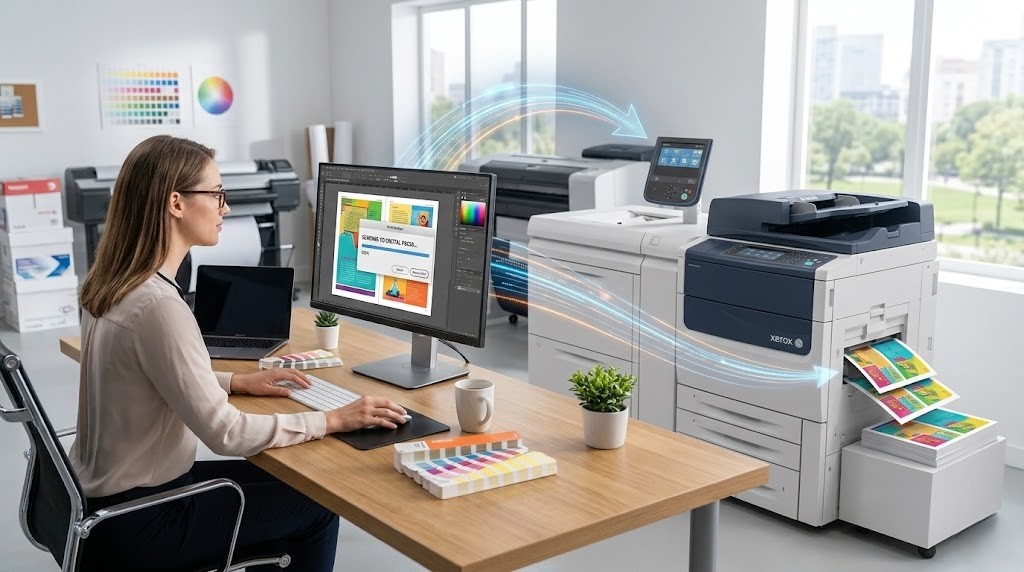
Digital printing is the modern method that prints directly from computer files to paper without plates or extensive setup. Think of it as a sophisticated, commercial-grade version of your office printer. print marketing effectiveness for small business
How Digital Printing Works
The process is straightforward:
- File Transfer: Your digital file goes directly to the printer
- Direct Imaging: Laser or inkjet technology applies toner/ink directly to paper
- Immediate Output: Printed sheets emerge ready for finishing
- No Intermediate Steps: No plates, blankets or extensive setup required
This direct printing method enables quick turnaround and cost-effectiveness for shorter runs.
Digital Printing Characteristics
| Feature | Digital Printing |
|---|---|
| Setup Requirements | Minimal (load paper, import file) |
| Setup Time | 15–30 minutes |
| Setup Cost | $0–100 (minimal to none) |
| Print Speed | Moderate (1,000–3,000 sheets/hour) |
| Per-Unit Cost | Consistent regardless of quantity |
| Minimum Practical Quantity | Even single copies economical |
| Colour Accuracy | Very good (CMYK process colours) |
| Image Quality | Excellent for most applications |
| Paper Options | Wide selection (some limitations) |
| Variable Data | Easily personalized (names, addresses, images) |
When Digital Printing Excels
Digital printing is the superior choice for:
- Short runs (typically under 1,000 units)
- Projects requiring quick turnaround (24-72 hours)
- Variable data printing (personalization)
- Test runs before committing to larger quantities
- On-demand printing (print only what you need)
- Projects where setup costs would be prohibitive

The Cost Comparison: Breaking Down the Numbers
Understanding the economics of each method is crucial for smart decision-making. Let’s examine real-world cost scenarios.
Cost Analysis by Quantity
| Quantity | Digital Printing | Offset Printing | Best Choice |
|---|---|---|---|
| 100 flyers | $80–120 | $350–450 | Digital (75% savings) |
| 500 flyers | $180–250 | $380–480 | Digital (50% savings) |
| 1,000 flyers | $280–380 | $400–500 | Close call (digital slightly better) |
| 2,500 flyers | $600–800 | $550–650 | Offset (15–20% savings) |
| 5,000 flyers | $1,100–1,500 | $700–900 | Offset (40–50% savings) |
| 10,000 flyers | $2,000–2,800 | $900–1,200 | Offset (60–70% savings) |
The Break-Even Point: For most standard projects, offset becomes more economical around 1,000-1,500 units. However, this varies based on project complexity, paper choice and colour requirements. true cost of printing in Canada
Understanding the Economics
Digital Printing Cost Structure:
- Low/no setup costs
- Consistent per-unit pricing
- Total cost increases linearly with quantity
- Formula: Total Cost = (Per-Unit Cost × Quantity) + Minimal Setup
Offset Printing Cost Structure:
- High initial setup costs
- Low per-unit costs after setup
- Total cost increases slowly after initial investment
- Formula: Total Cost = High Setup Fee + (Low Per-Unit Cost × Quantity)
Real-World Example from St. Catharines
A local restaurant needed 250 dinner menus updated quarterly. They initially chose offset printing thinking it would be cheaper.
Offset Printing (per order):
- Setup fees: $400
- 250 menus printed: $180
- Total: $580 per order × 4 quarters = $2,320 annually
Digital Printing (per order):
- Setup fees: $0
- 250 menus printed: $220
- Total: $220 per order × 4 quarters = $880 annually
By switching to digital printing, they saved $1,440 annually while maintaining the flexibility to update designs quarterly without penalty.
Quality Comparison: Can You See the Difference?
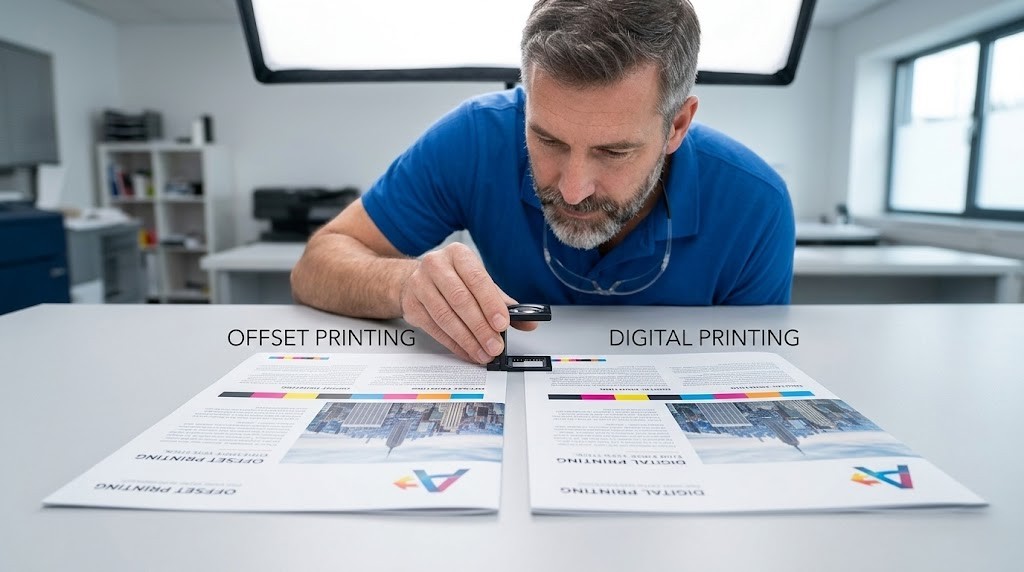
The quality question dominates many printing decisions. Let’s separate perception from reality.
Quality Factors Compared
| Quality Aspect | Offset Printing | Digital Printing | Noticeable Difference? |
|---|---|---|---|
| Overall Sharpness | Exceptional | Excellent | Minimal for most viewers |
| Colour Consistency | Excellent (within run and between runs) | Very good (slight variation possible) | Professionals may notice |
| Fine Detail Reproduction | Superior (especially small text) | Excellent (very close) | Minimal in most applications |
| Solid Colour Coverage | Excellent (no banding) | Very good (rare banding on large areas) | Sometimes visible on large solids |
| Pantone Colour Matching | Available (spot colours) | Limited (CMYK approximation) | Very noticeable for brand colours |
| Gradients & Blends | Smooth and flawless | Very smooth (occasional stepping) | Rarely noticeable |
The Truth About Quality Differences
For Most Business Applications: The quality difference between modern digital and offset printing is negligible. Clients, customers and prospects cannot tell the difference in:
For Most Business Applications:
The quality difference between modern digital and offset printing is negligible. Clients, customers and prospects cannot tell the difference in:
- Business cards
- Standard brochures and flyers
- Marketing materials
- Letterhead and stationery
- Most colour printing applications
When Offset Quality Matters:
- Brand-critical colour matching (logos, corporate colours)
- Large solid colour areas (where banding might show)
- Very fine text or detailed graphics
- High-end photography reproduction
- Luxury brand materials where perception matters
A Pelham design agency conducted blind tests with 50 clients, showing identical business cards printed digitally and offset. Only 3 people (6%) correctly identified which was which—and they were professional designers themselves. choosing between 80lb, 100lb and 130lb stock
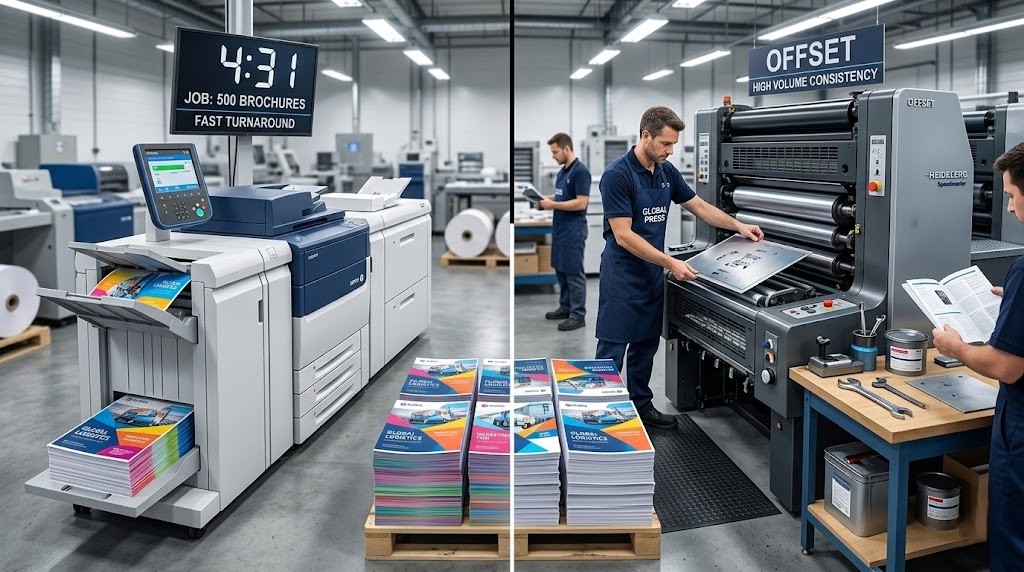
Timeline Comparison: Speed vs Consistency
Project deadlines often determine which printing method you choose.
Turnaround Time Comparison
| Project Type | Digital Printing | Offset Printing |
|---|---|---|
| Business Cards (1,000) | 1–2 days | 5–7 days |
| Flyers (5,000) | 2–3 days | 5–8 days |
| Brochures (2,500 tri-fold) | 2–4 days | 7–10 days |
| Rush Service Available? | Often same-day or next-day | Rarely (setup required) |
| Reprint Timing | Identical to original | Identical to original |
Digital Advantage: Speed. When you need materials quickly, digital printing delivers in a fraction of the time.
Offset Advantage: Consistency. Once plates are made, exact reprints are guaranteed for years—critical for maintaining brand standards across long campaigns.
Real-World Timing Scenario
A Niagara Falls tourism company needed 3,000 brochures for a trade show in 4 days. Offset printing required 7-10 days minimum. They chose digital printing at Niagara Print Express and received finished brochures in 3 days—saving their trade show presence.
While they paid approximately $120 more than offset would have cost, avoiding the trade show booth cost (minimum $2,500) made digital printing the obvious choice.
Variable Data Printing: Digital's Unique Advantage
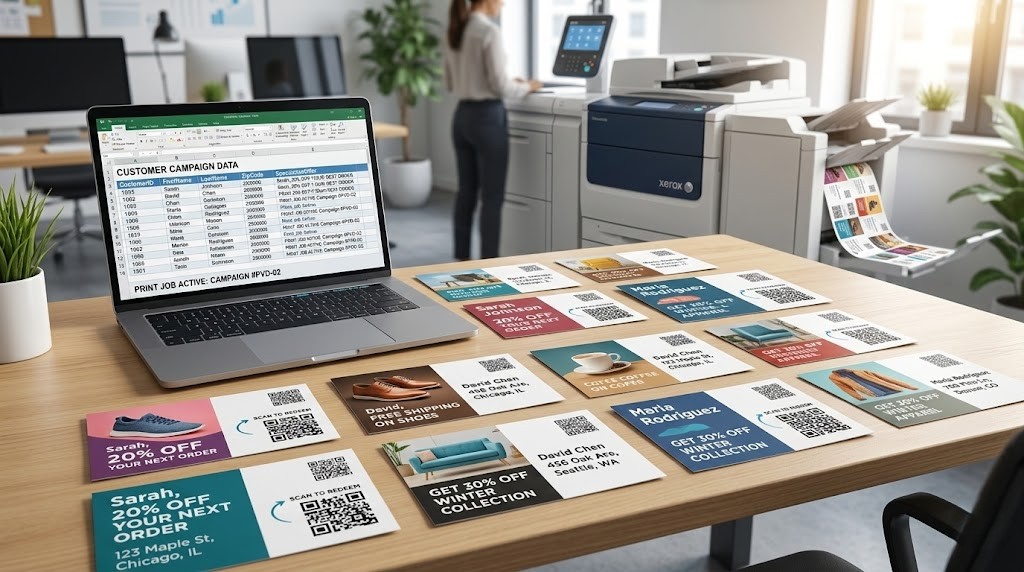
Digital printing offers one capability that offset simply cannot match: variable data printing.
What is Variable Data Printing?
Variable data printing allows each printed piece to be customized with different:
- Names and personalized greetings
- Addresses and contact information
- Unique images or photos
- Custom URLs and QR codes
- Sequential numbering
- Personalized offers based on recipient data
Variable Data Applications
| Application | Example | Business Impact |
|---|---|---|
| Direct Mail Campaigns | Personalized postcards with recipient’s name | 135% higher response rate vs generic mail |
| Event Materials | Name badges, personalized invitations | Enhanced attendee experience |
| Membership Cards | Individual names and numbers | Professional, secure identification |
| Fundraising Appeals | Customized donation amounts and history | 74% higher donation conversion |
| Real Estate Marketing | Property-specific details per neighbourhood | Higher engagement with targeted messaging |
A Grimsby real estate agent used variable data printing for targeted neighbourhood marketing. Each postcard featured recently sold homes specific to that street, with personalized messages referencing local landmarks. Response rate increased 280% compared to generic postcards—all at virtually the same cost per piece as standard digital printing.
This capability alone makes digital printing invaluable for modern marketing campaigns.
Paper and Substrate Options
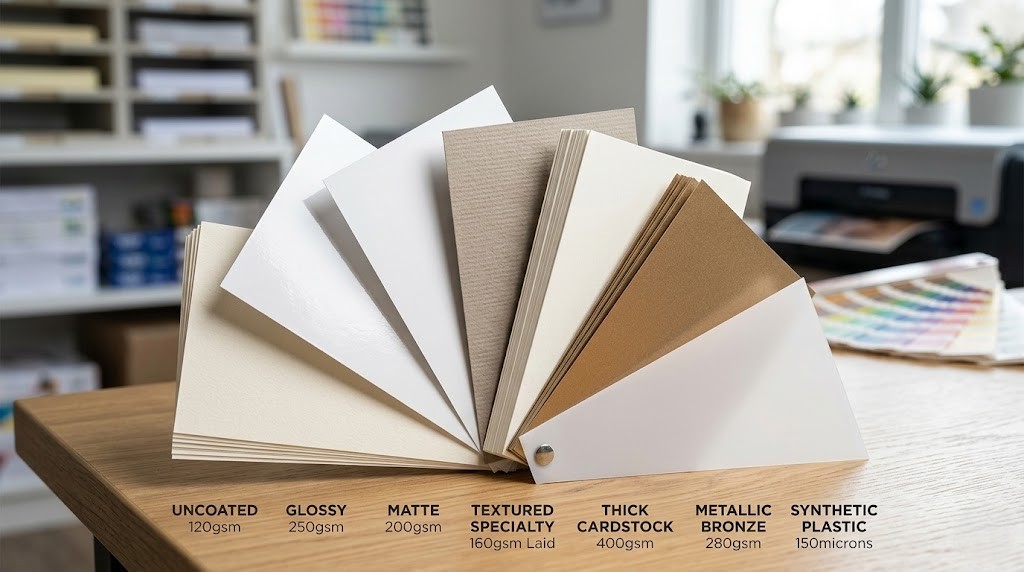
Both printing methods work with various materials, but offset printing offers broader compatibility.
Material Compatibility
| Material Type | Digital Printing | Offset Printing |
|---|---|---|
| Standard text weights (60–100lb) | Excellent | Excellent |
| Heavy cover stocks (100–130lb) | Very good | Excellent |
| Extremely heavy cardstock (18pt+) | Limited | Excellent |
| Uncoated papers | Excellent | Excellent |
| Coated papers (gloss, matte) | Excellent | Excellent |
| Textured / specialty papers | Good (some limitations) | Excellent |
| Synthetic materials (plastic, vinyl) | Limited | Excellent |
| Metallic papers | Good | Excellent |
| Extremely thin papers | Challenging | Excellent |
Key Insight: For standard business printing (80lb-130lb stocks on common papers), both methods perform excellently. Offset’s advantages emerge with unusual substrates, extremely heavy stocks or specialty materials.
If you’re printing on standard paper weights like 100lb text or 100lb cover, either method will work perfectly.
Specialty Finishes and Techniques
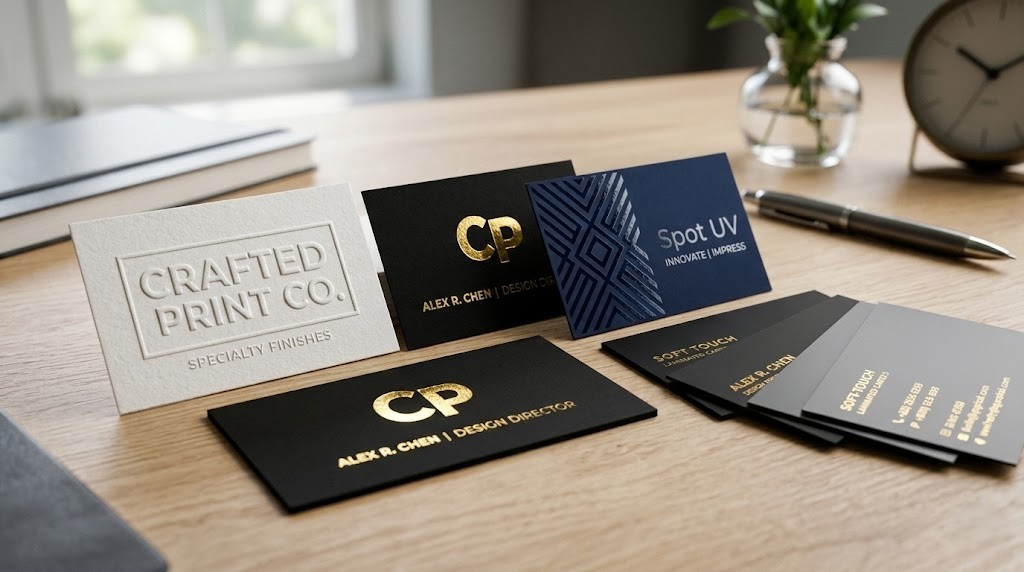
Your finishing requirements might determine which printing method you choose.
Available Finishes by Method
| Finish / Technique | Digital | Offset | Notes |
|---|---|---|---|
| Gloss / Matte Lamination | Available | Available | Equal quality both methods |
| Soft-Touch Lamination | Available | Available | Equal quality both methods |
| Spot UV Coating | Available | Available | Offset slightly easier / cheaper |
| Embossing | Available | Available | Same post-printing process |
| Foil Stamping | Available | Available | Same post-printing process |
| Die Cutting | Available | Available | Same post-printing process |
| Metallic Inks | Not available | Available | Offset exclusive |
| Fluorescent Inks | Not available | Available | Offset exclusive |
| Pantone Spot Colours | Limited | Full range | Offset advantage for brand matching |
Most finishes apply equally to both printing methods since they’re added after printing. The primary difference lies in ink options—offset supports specialty inks that digital cannot reproduce.
Environmental Considerations
Sustainability increasingly influences printing decisions for Canadian businesses.
Environmental Impact Comparison
| Factor | Digital Printing | Offset Printing |
|---|---|---|
| Chemical Usage | Minimal (toner-based) | Moderate (ink, fountain solution) |
| Waste Production | Very low (minimal setup waste) | Higher (setup sheets, plate development) |
| Energy Consumption | Lower (no extended setup) | Higher (plate making, lengthy setup) |
| Paper Waste | Minimal (print exact quantity needed) | Higher (setup requires test sheets) |
| On-Demand Advantage | Print only what’s needed | Encourages overprinting for economy |
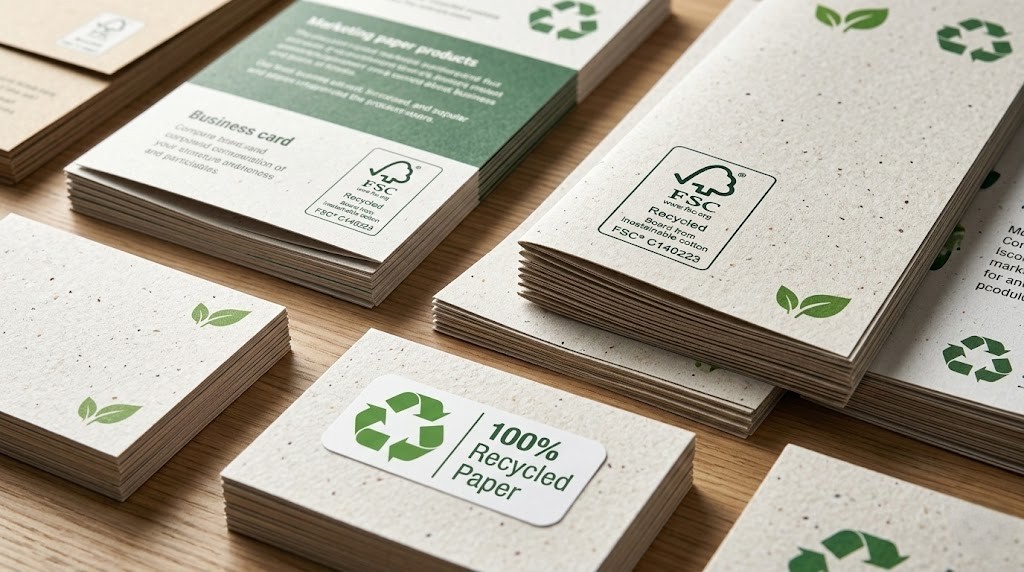
| Recycled Paper Compatibility | Excellent | Excellent |
Digital Environmental Advantage: Less waste, lower energy use and on-demand capability mean printing only what you need reduces environmental impact significantly.
Offset Consideration: While individual runs produce more waste, extremely large runs can be more efficient per unit than digital due to economies of scale.
Many Niagara Region businesses choose digital printing for shorter runs as part of their sustainability initiatives, avoiding the overprinting that offset economics encourage.
Making Your Decision: A Practical Framework
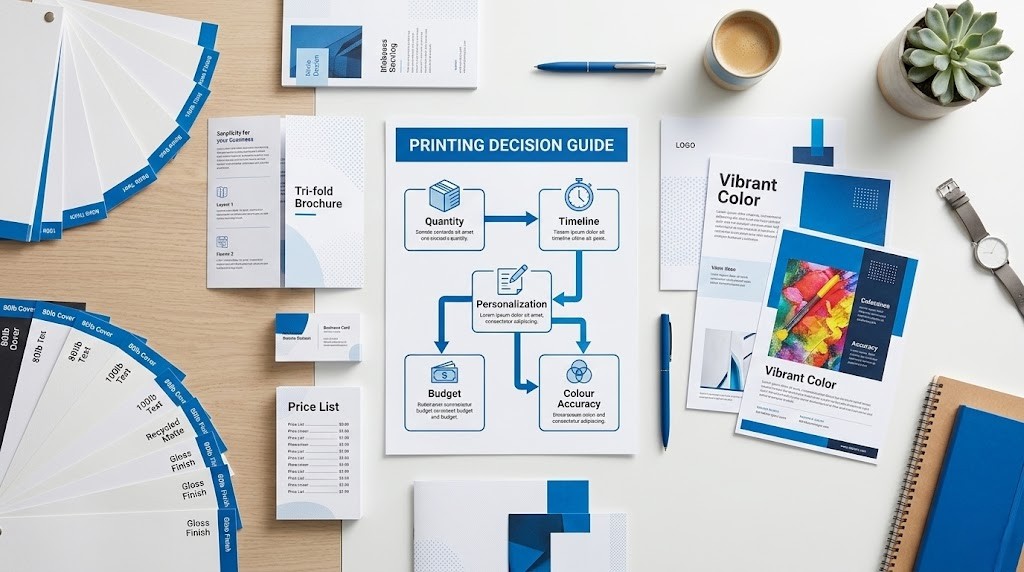
Use this decision tree to choose the right printing method for your project.
Quick Decision Guide
Think about the user journey with your printed piece:
Step 1: What's your quantity?
- Under 500 units → Digital printing (almost always)
- 500-1,500 units → Depends on other factors (continue to Step 2)
- Over 1,500 units → Offset printing (usually more economical)
Step 2: What's your timeline?
- Need it in 1-3 days → Digital printing (only realistic option)
- 4-7 days acceptable → Either method works
- 7+ days available → Either method works (offset quality advantage)
Step 3: Do you need variable data/personalization?
- Yes → Digital printing (only option for variable data)
- No → Continue to Step 4
Step 4: Is exact Pantone colour matching critical?
- Yes (brand-critical colours) → Offset printing (spot colour capability)
- No (standard CMYK acceptable) → Either method works
Step 5: What's your budget?
- Under $300 total → Digital printing (offset setup costs prohibitive)
- $300-800 → Depends on quantity and timing
- Over $800 → Evaluate cost per unit (likely offset at higher quantities)
Hybrid Strategy: Best of Both Worlds
Smart businesses in the Niagara Region often use both methods strategically:
Digital Printing For:
- Short runs and tests
- Quick-turnaround needs
- Personalized marketing campaigns
- Materials that change frequently
- On-demand restocking
Offset Printing For:
- Large campaigns (5,000+ pieces)
- Brand-critical materials requiring exact colour matching
- Long-term inventory (business cards, stationery)
- Premium quality applications
- Materials using specialty inks or techniques
This approach optimizes both cost and quality across your entire printing portfolio.

Common Misconceptions Debunked
Let’s address the myths that cause poor printing decisions.
Offset is Always Higher Quality
Reality: Modern digital printing quality rivals offset for most business applications. Unless you’re a professional printer or designer, you likely cannot distinguish between them in finished pieces.
Digital is Always Faster
Reality: While digital setup is faster, offset printing runs at higher speeds. For 10,000 pieces, offset might actually finish faster despite longer setup time.
You Can't Get Pantone Colours with Digital
Reality: Partially true. Digital can approximate Pantone colours using CMYK, often getting very close. For absolute brand-critical matching, offset remains superior. Learn more about colour accuracy in CMYK vs RGB printing.
Offset is Obsolete Technology
Reality: Offset printing remains the dominant method for magazines, newspapers, packaging and high-volume commercial printing. It’s evolved continuously and remains superior for many applications.
Key Takeaways: Smart Printing Method Selection
Choosing between offset and digital printing doesn’t require technical expertise—just understanding these fundamentals:
- Quantity drives economics—digital wins under 1,000 units, offset wins above 1,500-2,000 units
- Timeline matters critically—digital delivers in days, offset requires week-plus for setup and production
- Quality differences are minimal for standard business printing, noticeable mainly for specialty applications
- Variable data capability makes digital printing essential for personalized marketing campaigns
- Hybrid approaches work best—use each method where it provides the best value
Most importantly, work with a printer who offers both methods and will honestly recommend the best choice for each project rather than pushing you toward their preferred equipment.
Your Printing Method Expert
At Niagara Print Express, we maintain both state-of-the-art digital printing equipment and offset printing capabilities. This means we recommend the method that genuinely serves your project best—not the method that’s most convenient for us.
We offer:
- Free consultations comparing costs, quality and timing for both methods
- Sample prints showing quality differences (or lack thereof) for your specific design
- Transparent pricing for both digital and offset options
- Honest recommendations based on your budget, timeline and quality needs
- Hybrid solutions optimizing your printing investment across multiple projects
Don’t let confusion about printing methods cost you money or compromise quality.
Ready to choose the perfect printing method for your project? Visit our contact page to schedule a consultation or call us at (289) 897-9026 to discuss your printing needs. Check our resources library for additional guides on choosing printing methods. Let’s ensure you get the best quality at the best price.

We print almost everything!
Didn't find what you're looking for?
We print almost everything! Contact us for custom requests.
Frequently Asked Questions (FAQs)
What is the main difference between offset and digital printing?
Offset printing uses metal plates and a traditional press to transfer ink onto paper, making it ideal for large print runs with consistent quality. Digital printing prints directly from a digital file without plates, making it faster and more cost-effective for small quantities.
Which printing method is cheaper: offset or digital?
Digital printing is usually cheaper for short print runs under 1,000 units because it has little to no setup cost. Offset printing becomes more economical for larger quantities since the per-unit cost decreases significantly after the initial setup.
Is offset printing better quality than digital printing?
Offset printing can produce slightly sharper details and exact Pantone colour matching, which is useful for brand-critical projects. However, modern digital printing delivers excellent quality that is nearly indistinguishable for most marketing materials, business cards, and brochures.
When should I choose digital printing?
Digital printing is best for small quantities, quick turnaround projects, personalized printing, and materials that change frequently. It is commonly used for flyers, short-run brochures, and direct mail campaigns.
When should I choose offset printing?
Offset printing is ideal for large print runs, colour-critical projects, and materials that require specialty inks or coatings. It is commonly used for magazines, large brochure runs, catalogues, and packaging.
Can digital printing match Pantone colours?
Digital printing can approximate Pantone colours using CMYK inks, but exact Pantone spot colour matching is typically only available with offset printing.
Which printing method is faster?
Digital printing is generally faster because it requires minimal setup and can produce prints within hours or days. Offset printing takes longer due to plate creation and press setup but becomes very efficient for high-volume runs.
Can both offset and digital printing use the same paper types?
Both methods work well with most standard papers such as text and cover stocks. However, offset printing supports a wider range of specialty materials and extremely heavy stocks.
Add a Comment