
 Cart is empty
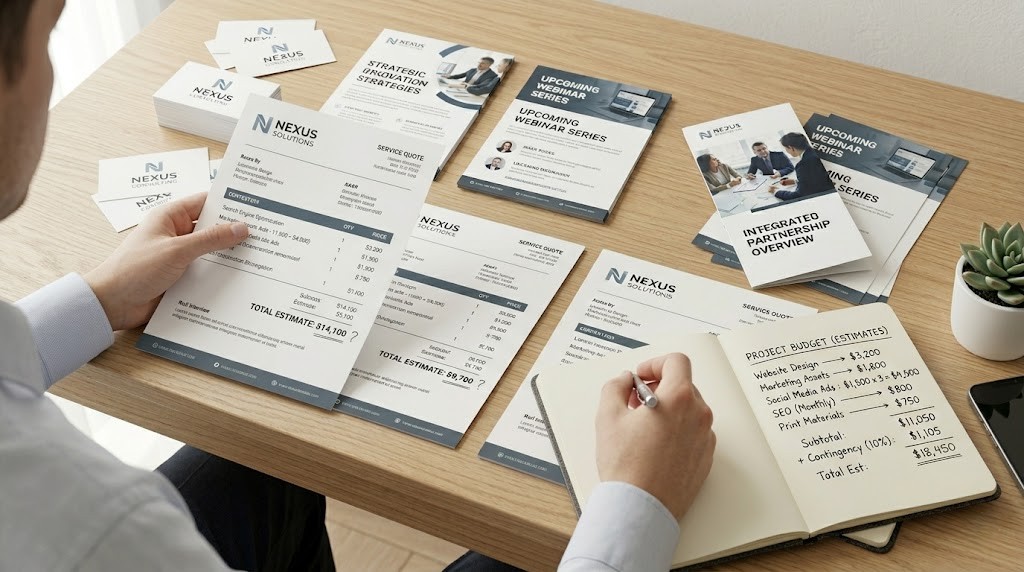
Understanding Your Print Budget: Why Pricing Feels Like a Mystery
You need 1,000 business cards. One printer quotes $150, another quotes $350, and a third quotes $85. Same quantity, same size, wildly different prices. What gives?
For small business owners, marketing managers, and entrepreneurs across the Niagara Region and beyond, print pricing feels like a black box. You know you need professional marketing materials, but understanding what you’re actually paying for—and whether you’re getting good value—remains frustratingly unclear.
This confusion leads to costly mistakes: overpaying for basic jobs, choosing inadequate quality to save money, or worse, avoiding print marketing entirely because you can’t confidently budget for it.
Small business owners (5-50 employees) managing their own marketing
Marketing coordinators allocating limited budgets across multiple channels
Startup founders making their first professional printing purchases
Entrepreneurs in retail, hospitality and local businesses who need to understand print economics
The challenge isn’t just getting the lowest price—it’s understanding what drives costs so you can make informed decisions that balance quality, budget, and business needs. Let’s demystify print pricing and give you the knowledge to confidently navigate your next print project.

What Actually Determines Print Costs?
Before examining specific products, understanding the fundamental cost drivers helps you evaluate any quote intelligently.
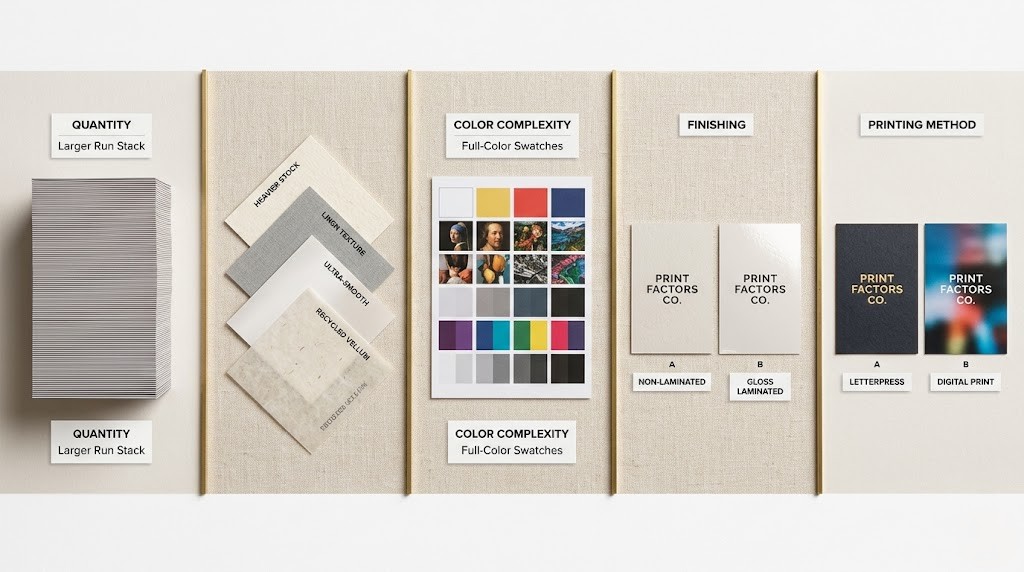
The Five Primary Cost Factors
| Cost Factor | Impact on Price | Your Control Level |
|---|---|---|
| Quantity | 40–60% of total cost variation | High – You decide volume |
| Paper Quality | 15–30% of total cost | High – Multiple options available |
| Colour Complexity | 10–20% of total cost | Medium – Design-dependent |
| Finishing Options | 5–25% of total cost | High – Optional upgrades |
| Printing Method | 20–40% of cost variation | Medium – Depends on quantity |
Quantity: The Most Misunderstood Factor
Many business owners assume printing costs scale linearly—if 500 business cards cost $100, then 1,000 should cost $200. This assumption causes budget miscalculations.
The Reality of Print Economics:
Printing has fixed costs (setup, file preparation, equipment calibration) and variable costs (paper, ink, labour per unit). Fixed costs get distributed across your print run, meaning per-unit costs decrease dramatically as quantity increases.
Example Economics:
- 250 business cards might cost $0.32 per card
- 500 business cards might cost $0.22 per card
- 1,000 business cards might cost $0.15 per card
- 2,500 business cards might cost $0.09 per card
A Pelham consulting firm initially ordered 250 business cards quarterly to “stay flexible” with design updates. After calculating their annual spend, they realized ordering 1,000 cards annually—even if some became outdated—saved them money overall while maintaining better quality stock.
Paper Quality: Where Value Lives
Paper quality represents one of the most significant value opportunities in print pricing. The difference between adequate and premium paper stock often costs less than business owners expect, while the perceived quality difference substantially impacts brand impression.
Paper Quality Tiers:
| Paper Tier | Characteristics | Best For | Typical Cost Impact |
|---|---|---|---|
| Economy | Thin, basic weight, standard finish | Internal documents, short-term use | Baseline cost |
| Standard | Professional weight, good opacity | Most business applications | +15–25% |
| Premium | Heavy stock, superior finish, excellent feel | Client-facing materials, brand-critical items | +30–50% |
| Luxury | Specialty papers, unique textures, exceptional weight | High-end brands, VIP materials | +60–100% |
Understanding paper weight differences helps you choose appropriately without overspending or under-delivering on quality.
Colour Complexity: Beyond "Full Colour"
Not all colour printing costs the same. The complexity of your design affects production costs in ways that aren’t immediately obvious.
Colour Cost Considerations:
- Simple designs (one or two solid colours, minimal gradients) run efficiently
- Complex designs (photographs, detailed graphics, extensive colour blends) require more careful colour management
- Colour-critical work (exact brand colour matching, Pantone requirements) needs additional calibration
- Specialty colours (metallic inks, fluorescent colours) significantly increase costs
For businesses serious about brand consistency, understanding CMYK versus RGB colour systems prevents costly colour disappointments and reprints.
Finishing Options: Where Premiums Add Up
Finishing encompasses everything that happens after printing: cutting, folding, laminating, coating, and binding. These additions enhance durability, appearance, and functionality—but each comes with associated costs.
Common Finishing Options:
| Finishing Type | Purpose | Value Proposition | Relative Cost |
|---|---|---|---|
| Standard Cut | Basic trimming to size | Included in base pricing | Included |
| Folding | Brochures, greeting cards | Functional necessity | +10–15% |
| Gloss / Matte Lamination | Protection, enhanced appearance | Durability + professional look | +20–35% |
| Spot UV | Selective high-gloss areas | Premium visual impact | +30–50% |
| Embossing / Debossing | Raised or recessed elements | Tactile luxury appeal | +40–80% |
| Foil Stamping | Metallic accents | Premium brand positioning | +50–100% |
The question isn’t whether these finishes are “worth it”—it’s whether they’re worth it for your specific application and audience. Premium finishes on internal training materials waste budget; the same finishes on client presentation materials can justify significantly higher pricing for your services.
Business Cards: Understanding the Price Range
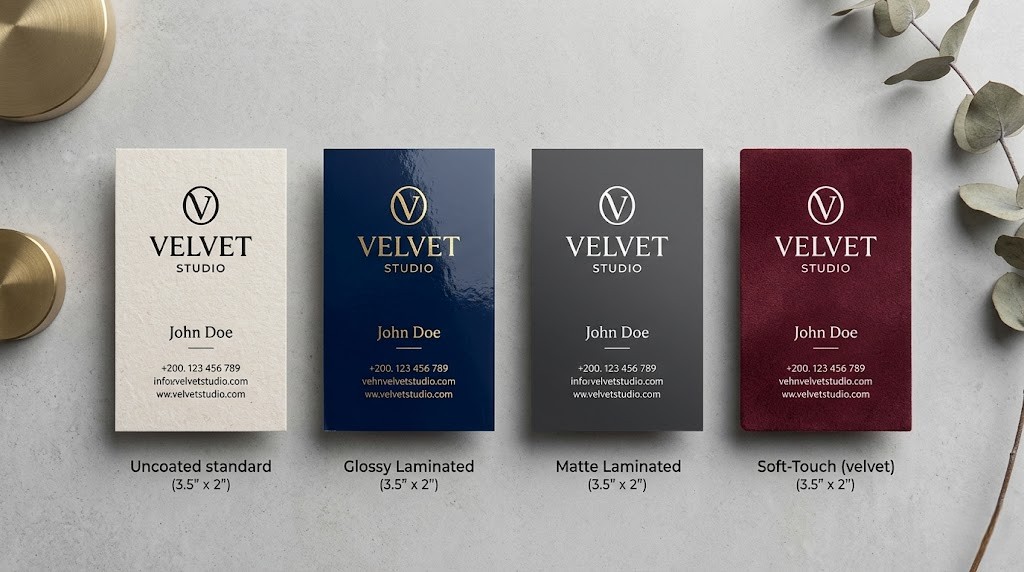
Business cards represent the most common—and most confusing—print purchase for businesses. Quotes vary dramatically because “business cards” encompasses a spectrum of quality levels.
What Drives Business Card Pricing
Standard Business Cards (100lb-110lb cover stock):
These represent the professional baseline. Printed on quality cardstock with standard cutting, they serve their purpose effectively for most business contexts.
Typical characteristics:
- Professional weight and thickness
- Clean, precise cutting
- Standard CMYK colour printing
- No protective coating
- Appropriate for general networking and business use
Premium Business Cards (130lb+ cover stock with finishing):
Premium options add weight, protective coatings, specialty finishes, or unique paper stocks that create memorable impressions.
Enhancement options include:
- Heavier cardstock (more substantial feel)
- Lamination (gloss, matte, or soft-touch for durability)
- Spot UV (selective high-gloss elements)
- Rounded corners (distinctive appearance)
- Specialty stocks (textured, metallic, kraft paper)
Business Card Cost Breakdown by Component
| Component | Economy Choice | Standard Choice | Premium Choice |
|---|---|---|---|
| Base Printing | Basic digital print | Quality digital print | High-end digital or offset |
| Paper Stock | 100lb cover | 110–120lb cover | 130lb+ cover or specialty |
| Finishing | Standard cut only | Standard cut + basic coating | Multiple finishes available |
| Per-Unit Impact | Baseline | +30–50% vs economy | +80–150% vs economy |
Business cards represent the most common—and most confusing—print purchase for businesses. Quotes vary dramatically because “business cards” encompasses a spectrum of quality levels.
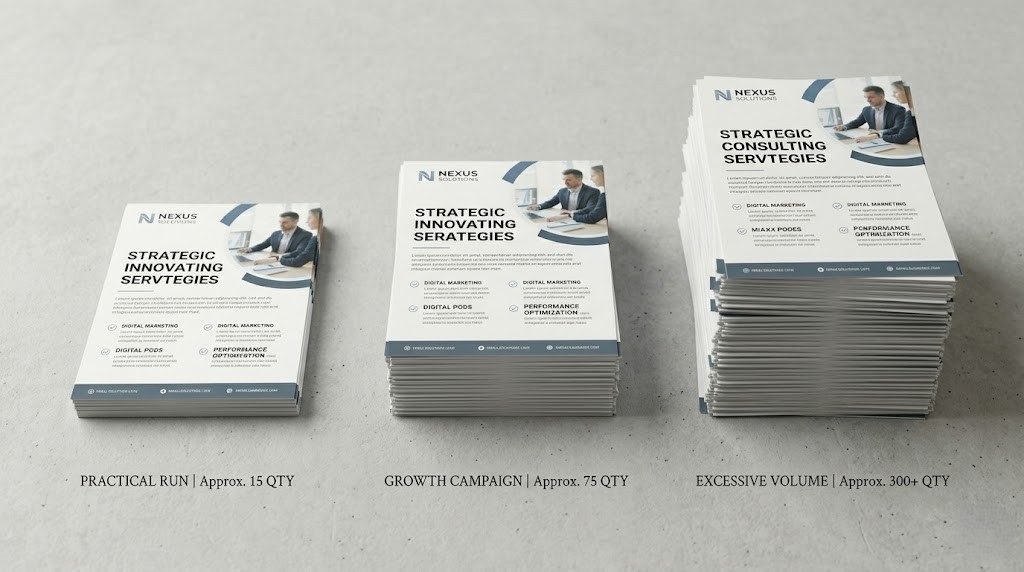
Flyers: Balancing Volume and Impact
Flyers present a unique pricing challenge because they’re typically high-volume items where cost-per-unit matters significantly, yet they must still attract attention and communicate professionally.
Volume Economics of Flyer Printing
Flyers demonstrate print economics most clearly. The per-unit cost drops dramatically with volume, but the decision isn’t simply “order more to save money”—it’s about matching quantity to realistic distribution.
Distribution Reality Check:
Small businesses often overestimate their distribution capacity. Printing 10,000 flyers to get a better per-unit price seems smart until 7,000 of them sit in storage for months, becoming outdated or never distributed at all.
Strategic Volume Planning:
- Calculate realistic monthly distribution capacity
- Consider shelf life (seasonal promotions, time-sensitive offers)
- Factor storage space and organization
- Account for potential design updates or pivots
A Niagara Falls restaurant printed 15,000 flyers for their summer menu, attracted by the low per-unit cost. After summer ended, they had 9,000 unused flyers with outdated menu items and prices. Printing 5,000 would have cost slightly more per unit but significantly less overall—and every flyer would have been current and useful.
Flyer Paper Selection: Matching Weight to Purpose
Flyer paper weight directly correlates with cost, but the “right” choice depends on distribution method, lifespan, and brand positioning.
Paper Weight Decision Matrix:
| Distribution Method | Recommended Weight | Reasoning |
|---|---|---|
| Hand-to-Hand Distribution | 80lb–100lb text | Substantial enough to feel professional |
| Bulletin Board Posting | 80lb text | Adequate for tacking, cost-effective |
| Direct Mail | 80lb–100lb text | Balances postage costs with quality |
| Leave-Behind Materials | 100lb text | Durability for extended visibility |
| Premium Positioning | 100lb+ text or cover stock | Aligns with brand expectations |
Colour vs Black and White: The ROI Question
Full-colour flyers cost more than black-and-white or spot-colour options, but the response rate difference often justifies the investment.
Documented Response Differences:
- Black-and-white flyers: baseline response rate
- Single spot colour: 15-25% higher response than black-and-white
- Full-colour: 40-60% higher response than black-and-white
For many Niagara Region businesses, the incremental cost of full-colour printing is modest compared to the improved response rates. A direct mail campaign generating 40% more responses while costing 25% more per piece delivers better overall ROI.
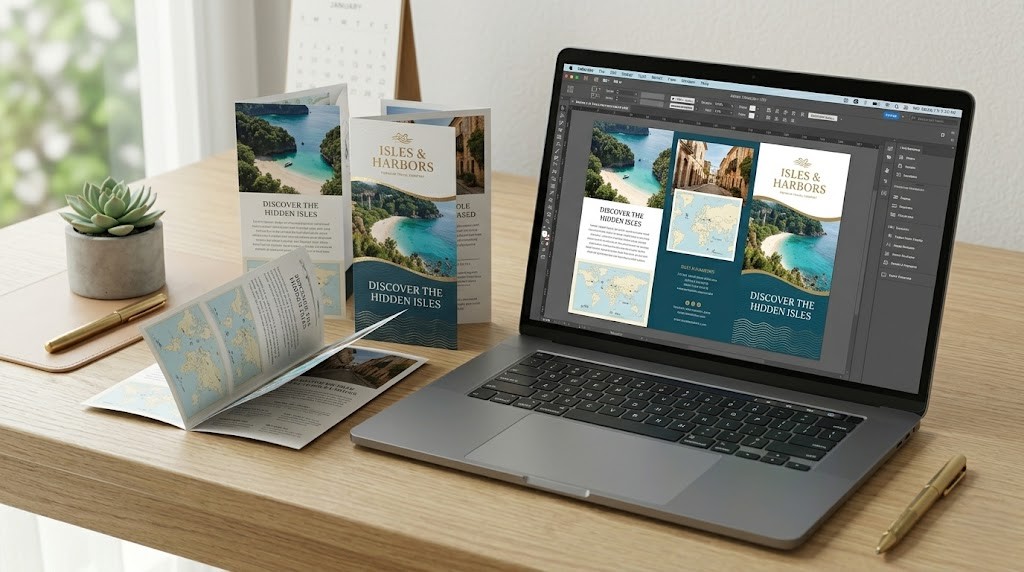
Brochures: Premium Positioning Through Print Quality
Brochures serve as comprehensive sales tools, often representing significant investment in design, copywriting, and photography. The print quality must match this investment—poor printing undermines expensive content development.
Brochure Complexity and Cost Drivers
Unlike business cards (standard size, relatively simple) or flyers (typically single-sheet), brochures involve multiple variables that affect pricing:
Configuration Variables:
- Size (standard letter, oversized, custom dimensions)
- Panel count (bi-fold, tri-fold, gate-fold, multi-page)
- Paper weight (interior vs cover)
- Printing method (offset vs digital)
- Finishing (folding, binding, coating)
The Hidden Cost: Design Complexity
Many businesses underestimate how design complexity affects print costs. A simple three-colour design with minimal graphics prints more economically than a photo-heavy layout with complex colour blending—even on the same paper stock.
Design Efficiency Considerations:
- Large solid colour areas can show printing artifacts (requiring premium equipment)
- Extensive photographs require careful colour management
- Bleeds and tight margins increase waste (affecting per-unit costs)
- Complex dielines for unusual folds add finishing costs
Working with experienced printing professionals during the design phase—before finalizing layouts—helps optimize for both visual impact and cost-efficiency.
Brochure Quantities: The Offset vs Digital Decision Point
Brochure quantity fundamentally affects which printing method makes economic sense, which then influences quality characteristics and capabilities.
Method Selection Guide:
| Quantity Range | Typically Best Method | Key Advantage |
|---|---|---|
| Under 500 | Digital printing | Low setup costs, quick turnaround |
| 500–1,500 | Either method (evaluate specific quotes) | Price competitive zone |
| 1,500–5,000 | Offset printing | Superior per-unit economics |
| Over 5,000 | Offset printing | Significant cost advantages |
The method affects more than just price—it influences colour consistency, paper options, and specialty ink availability. Understanding these tradeoffs helps you specify projects appropriately from the start.
Hidden Costs That Catch Businesses Off Guard
Beyond the obvious printing costs, several hidden expenses surprise first-time print buyers.
File Preparation and Design Adjustments
Professional printing requires properly prepared files. If your files aren’t print-ready, correction costs add up quickly.
Common File Issues:
- Incorrect colour mode (RGB instead of CMYK)
- Insufficient resolution (causing blurry results)
- Missing bleed (resulting in white edges or cut-off elements)
- Embedded fonts or image problems
- Incorrect dimensions or setup
These technical issues aren’t always obvious until the pre-press stage. Understanding proper bleed setup and other file requirements prevents delays and additional charges.
Rush Fees and Expedited Production
Standard turnaround times accommodate normal production scheduling. Rush service requires prioritizing your job over others, justifying premium pricing.
Rush Service Reality:
- Standard turnaround allows for optimal scheduling and cost-efficiency
- Rush service (24-48 hours) typically adds significant premiums
- Last-minute requests risk quality issues from compressed timelines
- Planning ahead saves money and stress
The Pelham business owner who needs rush business cards for tomorrow’s trade show pays substantially more than planning two weeks ahead would have cost.
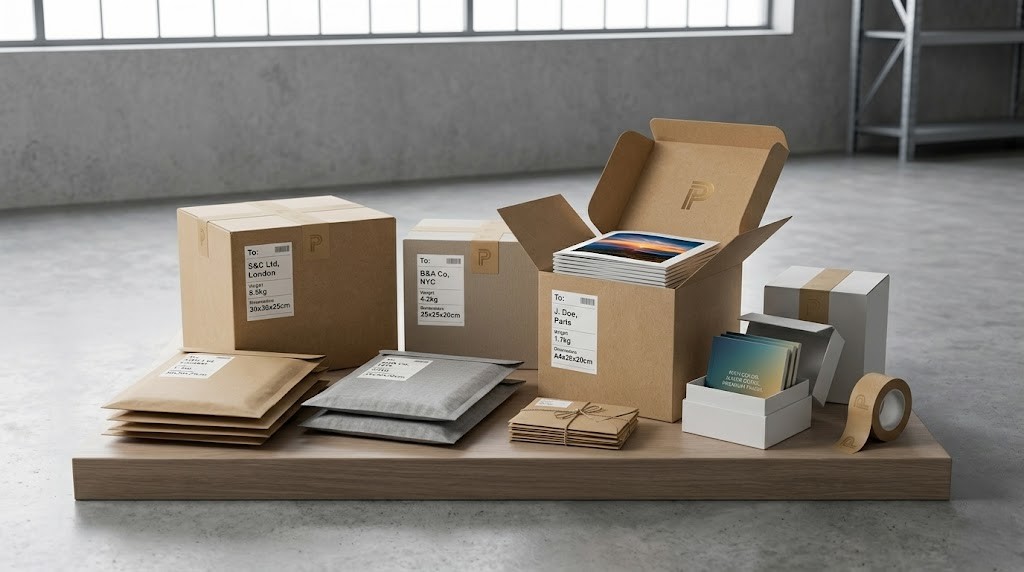
Shipping, Delivery, and Pickup Logistics
Getting printed materials from the printer to your location involves logistics costs that vary based on quantity, urgency, and distance.
Delivery Cost Factors:
| Factor | Impact on Cost |
|---|---|
| Weight / Quantity | Heavier shipments cost more |
| Distance | Local vs regional vs national shipping |
| Speed | Standard ground vs expedited |
| Packaging Requirements | Flat items vs rolled items vs special protection |
Local businesses in the Niagara Region benefit from pickup options that eliminate shipping costs entirely—a meaningful saving on large or frequent orders.
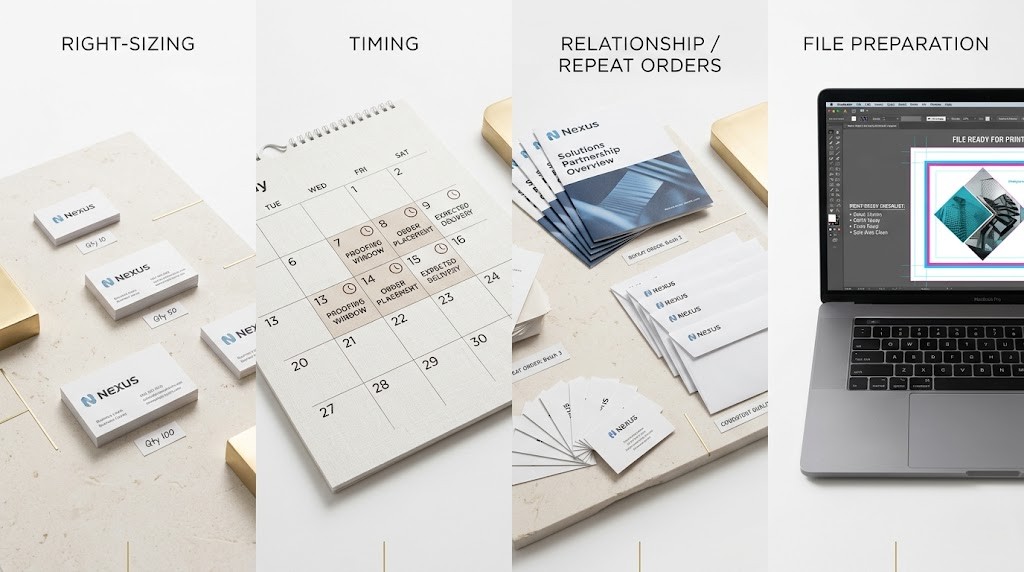
Smart Strategies for Managing Print Costs
Understanding costs means nothing without strategies to optimize spending while maintaining quality.
Strategy #1: Right-Sizing Your Orders
Bigger isn’t always better. While per-unit costs decrease with volume, total costs increase—and unused inventory represents wasted investment.
Right-Sizing Framework:
- Calculate realistic distribution timeline (monthly capacity × shelf life)
- Account for design updates (rebranding, seasonal changes, offer expiration)
- Consider storage logistics and costs
- Factor in cash flow (smaller orders preserve working capital)
Strategy #2: Strategic Timing
Planning print projects during slower business periods or ordering before urgent needs arise eliminates rush fees and allows for better pricing negotiation.
Timing Optimization:
- Batch similar projects to reduce setup costs
- Plan seasonal materials well in advance
- Maintain buffer inventory of evergreen items
- Avoid last-minute emergency orders
Strategy #3: Build Printer Relationships
Working consistently with a trusted local printing partner creates mutual value that translates into better service and pricing.
Relationship Benefits:
- Printers understanding your brand standards and preferences
- Priority service during busy periods
- Flexible payment terms for established customers
- Proactive recommendations for cost savings
- Quick turnaround on repeat orders (existing files and setup)
Many successful Niagara Region businesses report that their printing partner relationship saves them more than constantly shopping for the lowest quote ever could.
Strategy #4: Invest in Print-Ready Files
Properly prepared files from the start eliminate revision costs, reduce turnaround time, and prevent expensive reprints from technical errors.
File Investment Value:
- One-time investment in proper file setup
- Reusable for future print runs
- Eliminates correction fees
- Reduces proof cycles
- Prevents quality issues
Working with designers who understand print specifications—or learning print requirements yourself—pays dividends across every project.
Evaluating Print Quotes: Beyond the Bottom Line
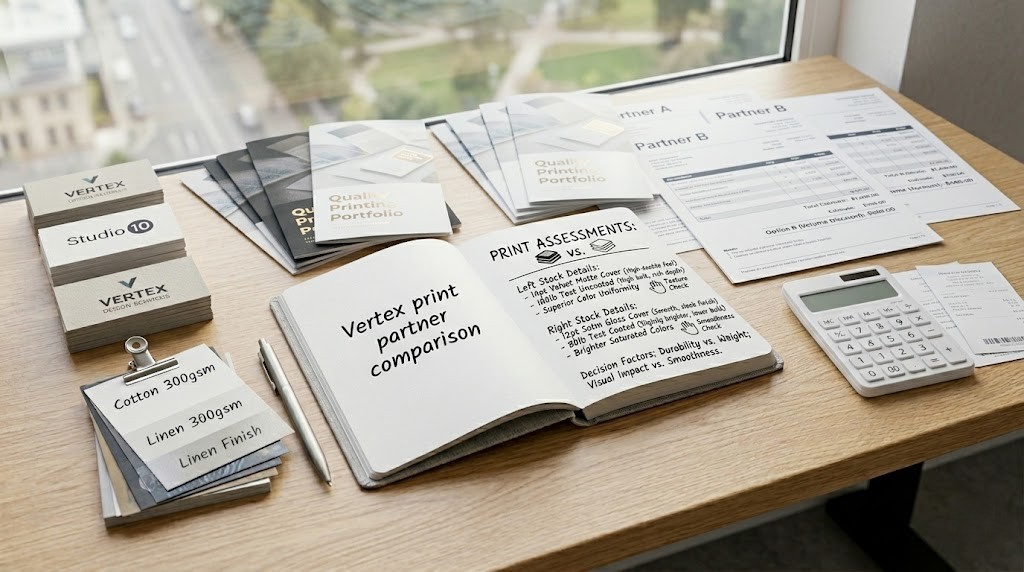
The lowest quote isn’t always the best value. Intelligent quote comparison considers multiple factors.
Quote Comparison Checklist
When evaluating competing quotes, ensure you’re comparing equivalent specifications:
- Identical quantities
- Same paper weight and quality
- Equivalent colour printing (CMYK vs RGB, colour management)
- Matching finishing options
- Comparable turnaround times
- Equivalent file preparation services
- Similar proof processes
- Consistent quality guarantees
A quote that’s 20% lower but uses lighter paper, skips protective coating, or doesn’t include proofing may actually deliver inferior value despite the lower price.
Red Flags in Print Pricing
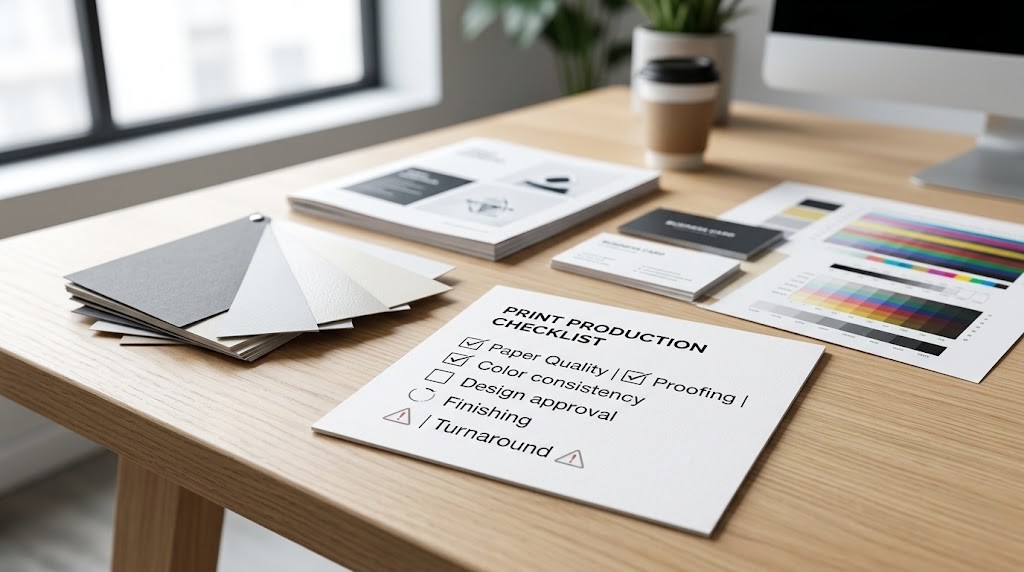
Certain pricing signals should prompt closer investigation:
Warning Signs:
- Prices dramatically below market (suggesting inferior materials or quality)
- Vague specifications (not detailing exact paper weights or finishing)
- No samples available (legitimate printers showcase their work)
- Unwillingness to provide detailed breakdowns
- No quality guarantee or reprint policy
Professional printing involves significant material and labour costs. Quotes far below market rates cut corners somewhere—the question is where, and whether those compromises affect your goals.
Making Confident Print Investment Decisions
Understanding print pricing isn’t about becoming an expert in printing technology—it’s about having sufficient knowledge to make informed decisions that balance quality, budget, and business objectives.
The businesses that get the best value from their print investments share common practices:
- They right-size orders based on realistic needs rather than pursuing lowest per-unit costs
- They plan ahead to avoid rush fees and allow time for quality production
- They understand that appropriate quality differs by application
- They build relationships with reliable printing partners
- They invest in proper file preparation
- They evaluate total value, not just bottom-line pricing
Your printed materials represent your business in physical form. They sit on desks, pass hand-to-hand, and create impressions that influence business decisions. Smart print investment—informed by understanding of cost drivers and value factors—ensures these impressions align with your brand positioning and business goals.
Your Partner in Print Investment Strategy
At Niagara Print Express, we believe in transparent, education-focused partnerships with our clients. Understanding what drives costs empowers you to make better decisions—whether you’re printing with us or evaluating other options.
We’re committed to:
- Honest recommendations based on your actual needs, not upselling unnecessary features
- Clear explanations of cost factors and tradeoffs
- Helping you optimize specifications for best value
- Proactive suggestions for cost-effective alternatives when appropriate
- Building long-term relationships where we understand your business and can anticipate needs
Print pricing shouldn’t feel like a mystery. We’re here to provide the transparency and expertise that transforms printing from a frustrating procurement task into a strategic marketing investment.
Ready to discuss your printing needs with a partner who prioritizes your success? Visit our contact page to start a conversation about your upcoming projects, or call us at (289) 897-9026 to speak with our team. Explore our resources library for additional guides on optimizing your print investments. Let’s work together to ensure every print dollar delivers maximum value for your business.

We print almost everything!
Didn't find what you're looking for?
We print almost everything! Contact us for custom requests.
Frequently Asked Questions (FAQs)
How much should I budget for business cards as a new business?
New businesses should budget based on their networking activity and growth phase. For startup founders actively networking, 500-1,000 business cards on quality 100lb-130lb cover stock provides a professional foundation. Standard quality cards serve effectively for most purposes; premium options make sense for high-end service providers or when cards represent a significant touchpoint with high-value clients.
Why do some online printers offer much lower prices than local printers?
Online printing companies achieve lower prices through automation, volume purchasing power, and standardized products. However, total cost comparisons should include shipping, lack of in-person consultation, longer turnaround times, and difficulty resolving issues. Local printers offer expertise, relationship value, quick turnaround, and accountability that often justify slightly higher base prices—particularly when considering total project costs and risk mitigation.
Is it worth paying more for premium paper stock?
Premium paper stock is worth the investment when printed materials directly influence business decisions or brand perception. For client-facing materials, proposal documents, premium product marketing, or luxury brand positioning, superior paper quality creates tangible differentiation. For internal documents, training materials, or temporary promotional items, standard quality typically suffices. The question isn't whether premium is "better"—it's whether the incremental cost delivers proportional value for your specific application.
How can I reduce printing costs without sacrificing quality?
Cost reduction without quality sacrifice focuses on smart specifications rather than cheaper materials. Strategies include: right-sizing quantities to actual needs, planning ahead to avoid rush fees, choosing appropriate rather than excessive paper weights, optimizing designs for print efficiency, building relationships with reliable printers, and investing in proper file preparation. Often, working with an experienced printing partner reveals cost-saving opportunities you wouldn't identify independently.
What's the real difference between digital and offset printing for my project?
Digital printing excels for shorter runs (typically under 1,000-1,500 units), quick turnaround needs, and variable data applications. Offset printing becomes more economical at higher volumes and offers advantages for colour-critical work requiring exact Pantone matching. For most business applications under 1,000 units, digital printing provides excellent quality at better economics. Above 1,500-2,000 units, offset typically delivers superior value. The "right" choice depends on your quantity, timeline, and specific quality requirements.
Should I order more to get a better per-unit price?
Order quantity should be based on realistic distribution capacity and shelf life, not solely on per-unit pricing. Calculate how many units you'll actually distribute within a reasonable timeframe (considering expiration dates, design updates, and storage limitations). Unused inventory represents wasted investment regardless of how low the per-unit cost was. Sometimes paying slightly more per unit for a smaller, appropriate quantity delivers better overall value than cheaper per-unit pricing on quantities you can't effectively use.
How do I know if I'm getting a fair price for printing?
Fair pricing evaluation requires comparing equivalent specifications from multiple reputable sources. Obtain detailed quotes specifying exact paper weights, printing methods, finishing options, and turnaround times. Compare these quotes on an apples-to-apples basis. Expect market-rate pricing to cluster within a reasonable range; outliers (either extremely high or suspiciously low) deserve investigation. Building relationships with trusted printing partners provides transparency into cost structures and confidence in fair pricing over time.
What questions should I ask when requesting a print quote?
Effective quote requests specify: exact quantities needed, preferred paper weight and finish, colour requirements (CMYK or spot colours), finishing options (lamination, coating, folding), turnaround timeline, delivery/pickup preferences, and file format you'll provide. Additionally, ask about: proof processes, reprint policies for quality issues, file preparation assistance availability, and quantity break points where pricing changes. Detailed specifications ensure accurate quotes and prevent surprises during production.

Shadab Alam
Shadab Alam is an entrepreneur and co-founder of NPE, specializing in print marketing, branding, and business growth strategies. With experience in building and scaling business initiatives, he focuses on helping companies use high-quality printed materials and creative marketing to strengthen their brand presence.
Add a Comment